Night Tree
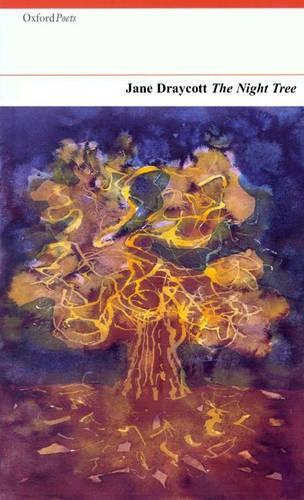
Night Tree
paperback
Published:
27 May, 2004

Popular Books by Jane Draycott
View All Books by Jane Draycott



Description
More Details
| Type | Book |
|---|---|
| ISBN13 | 9781903039724 |
| ISBN10 | 190303972X |
| Number Of Pages | 64 |
| Item Weight | 1000 g |
| Publisher / Reseller | Carcanet Press Ltd |
| Format | paperback |
Media Reviews
Reviewed by David Morley in The Guardian
Poetry persuades by the precision of its language, and this necessary exactness is carefully and coldly won over years of drafting and redrafting.Jane Draycott's first collection, Prince Rupert's Drop, was well received and rightly so.Her work had a patient intelligence of practice, and concision of address, not only in every poem in that book but in the very philosophy of perception informing her poetics.Her collection set a lofty point from which to advance.Happily for her growing number of readers The Night Tree goes even further in its elegance and imaginative force.
She succeeds because, in the end, it's down to her confidence: a writerly coolness coupled with a sense of a workable, completely engaged aesthetic.The price of precision can be perfectionism, an attitude that can result in freezing before the headlights of your own expectations.At this point in a poet's vocation, the resilience of a personality has a great say in whether or not artistic progress is made or not.In short, you either freeze or thaw.Everything experienced so far, everything written and read, decides that outcome.It is a learned process and the consequence is ultimately decisive and life-changing.It can precipitate artistic crisis: poetic careers can fall apart, the language becoming clinical or unraveled.
Not so for Draycott.The Night Tree is a calculated, amazing thaw, made up from icy, prickly detail.Her attention to detail has paid off hugely; and she knows he price of it.One example, from the sequence "Tide Away" (a series of meditations on the Thames), is the short poem, "It begins with razors", the lift-off point for which is that lightermen on the river once bought their pipes pre-packed, then threw them over-board.Here it is in full:
It begins with razors or lighters,
its sharpness or fire akin to a ship
that is passing, a fragment or sample
of something much bigger and further away
such as fathomless caverns of silver,
whole acres of indigo, saffron or hemp
or hillside on hillside of spices or tea
laid out like a rug to lie down on or sleep.
But capping the bowl like the door
to a furnace some made it last longer,
run cooler for breathing in deeper
its skyfuls of clouds, so that burdens
grown lighter could rise in the water
like palaces turning to smoke,
for a pipe once alight is a dream
which is now or is never and ends
like a pipe of disposable bones
washed up on the foreshore
where in the same place the body
of a river ran just before.
What Draycott manages in two sentences contains a world.It isn't just the concise audacity of the imagery created here that is persuasive ("sharpness of fire akin to a ship that is passing"; "capping the bowl like a door to a furnace"), it's also her adroit control of language within the determined rhythmic clarity of what's almost a sea-shanty form ("a pipe once alight is a dream / which is now or is never and ends / like a pile of disposable bones").It is very hard to write this simply, nor is it simple to set so many internal rhymes in place, their gears interlocking almost soundlessly, without making the poem clank as wildly as a cartoon grandfather clock.Draycott's confidence secures the registers and makes a fine, clear lyric.Moreover, she makes significance out of insignificance.Sat it out loud: you'll want to sing it in time.Time's the theme.
Like the best poets at the peak of confidence, Draycott can also be playful.The way she plays, however, is by making strange, such as in the poem "How he knew he was turning to glass", an artful examination of the proofs of that transformation: "By the playing like wind in his hair of exaltations / from the distant leper colony. /By the images of himself repeated in the candelabras / of his erections..."
Or she can play on expectations by taking something familiar, and setting it in another unrelated but again familiar context, and seeing what emerges.I enjoy any ceremony in which literature proposes to science.The children of such a coupling usually lack any dread of reason (while some poets fly the room at the smell of it).Draycott plainly enjoys this observance too, especially in a cunning poem in which Sherlock Holmes receives a fellowship from the Royal Society of Chemistry: "He appears for a moment to fade, lost / in the fog which encircles his head. / The microphone leans towards him / like a question shouted into the wind / Who are you waiting for on such a freezing night?Areas of his brain / are needless of fire, clear signals across / open ground.The carpet rolls its red road / out across centuries of snow. / And what is it you fear so greatly? / Disembodies mond swirls in freefall / beyond the window pane frost calculates / its way across the floor.As you value / your reason, keep away from the moor."
As you value your reason, the you probably value good poetry.I've waited some time to read something this intelligent, this sensuous and this crystalline.In fact The Night Tree is the finest collection I've read for ages.What are you waiting for?
Reviewed by Sean O'Brien in The Sunday Times, 14 November 2004-11-16
The Nigh Tree, Jane Draycott's second full collection, confirms that she possesses an imaginative intensity and concentration.This book includes Tideway, a set of poems arising during a period spent with Thames watermen.Water, drowning, transformation, the lost and found - these subjects are as old as poetry itself.Draycott remakes them with a close sensory weave and a light, compelling music.Her task is not to bring back reports but to immerse the reader's own imagination in her medium, liked the submerged diver/sleeper in Salvage: "Far off he hears the approaching engine / of her name, a deep chest knocking.In his hand / the blue flame flowers and he begins to cut. // Slowly he surfaces and in the empty air / of the house the river runs off his face like a song."
Sean O'Brien, The Belfast Telegraph
Saturday 1st January, 2005
Jane Draycott's The Night Tree includes the haunting, mesmeric Tideway poems, set among the Thames watermen. This book should be on the prize shortlists.
Full of Dreamers
Jane Griffiths, Poetry Review, volume 95: winter 2004-5
In The Night Tree, Jane Draycott's second collection from Carcanet/Oxford Poets, nothing is quite what it seems. In 'Night Driving', the journey in an unknown country becomes a hallucinatory vision of all Europe's wars, past and present, rolled into one, 'ahead, in the rear-view and burning.' In 'Set Like a Net', the circus people who 'imagine themselves, sewing on stars, walking / the wires, crossing the high pass to safety' prove to be Jews in Hitler's Germany, not performing but tortured, in hiding, fighting for their lives. These are night visions in every sense of the word, not least in their oliquity. Draycott has an extraordinary gift for transformation. Her metaphors are translucent, suggesting there is nothing that cannot be seen through or seen double.
In a poem such as 'Set Like a Net' this is purposely disturbing; elsewhere it exhilarates. In the stuninng title poem, it is impossible to say whether the tree is a metaphor for a ship or the other way around. Both possibilities have to be borne in mind simultaneously, so that the experience of reading the poem replicates the disorientation of the narrator in 'the sea / which is a forest' where:
time travels slowly
as if at great height or in exile and men
report voices heard crying in darkness,
though for myself I think it is only the seals
calling to each other in their language
through all the leafiness of the night.
Here, as so often in the collection, the dark becomes a metaphor for the unconscious weight of a shared history. In the final part of the work the Thames comes to serve something of the same purpose. The river is a strong physical presence, but it is also more than itself: the sum of all responses to it, or 'a fast-flowing rumour, / which runs throughout the day.' This dream-like quality is particulary apparent in 'Matchless', a sequence which floats lightly on its semi-submerged origin in the fourteenth-century dream vision Pearl. In the Middle English poem, a jeweller who mourns the death of his young daughter, imagining her as a pearl dropped in a garden, is granted a revelation of her as one of the bridges of Christ. Nonetheless, it is a poem of loss, ending with his rash attempt to plunge into the river that separates him from his daughter in New Jerusalem. 'Matchless' too deals with loss:
Lost to their father flawless
and small they slip, Margery
Rita and Pearl, into sleep
one August embankment.
The exact nature of the event is unspecified. At first it seems the lost girls are merely grown to adulthood. Yet the summer afternoon of the opening section shifts quickly to a nightmarish cityscape. Here the searching men may be predators rather than fathers; the girls may be runaway, homeless or drowned; and the river is at once a metaphor for the course of life and, literally, the end of it. As in 'Night Drive' the uncertainty as to what precisely is happening itself becomes the threat.
'The Night Tree' is full of dreamers, solitary figures who struggle to get a grip on their physical surroundings. There is the man who knew he was turning to glass, the fossil collector, the schoolboy mathematician for whom diagrams are 'a place / where mind's not agitated.' In Draycott's dangerously shifting world, their responses are only appropriate. Like the restorer of wall paintings or the salvage worker, and like Draycott herself, they are visionaries, making visible what was invisible, or at least providing new ways of seeing.
John Greening, Times Literary Supplement, 8th October 2004
Mists over water
Jane Draycott's quiet, meticulous poems inhabit the vague, evanescent world between waking and sleeping. Her vision is of an England half in dream, a Samuel Palmer twilight in which things begin to move into an unexpected focus: a field-system in shadow acknowledges vanished circus performers, the landscape in the dark of a camera recalls its dead photographer, suburban gardens come to sinister life, activity on the docks is distilled by "an alchemy" of the light to "an alternative world". Even individuals find themselves surreally metamorphosed ("How he knew he was turning to glass"). Amid so much that is visionary, it is no surprise to find Glastonbury Tor and Wayland's Smithy. But in the thirteen lines of "Pale", the poet turns, as Edward Thomas might have, to a simple "shepherd's church" where the restorer's "bed floats / through winter and each wall's a single day" and where you dream of what an X-ray might reveal: the bare bones of a landscape, pale saints like newborn animals before their adult coat, an almost invisible man.
These pieces seldom raise their voice. In fact, one of the most successful (and most stylistically conventional) is "The Note", about the "National Day of Silence", when citizens "surged on past, each tuning in to the note, / a rising river or advancing army from a long way off, / / a single note made by everything best left unsaid". This is a poet who knows when to leave things unsaid. The opening poem of The Night Tree even begins with the word "Secondly . . .", assuming prior knowledge of dull preliminaries, such as where the poem is set, who is speaking, what is happening. These poems have to be worked at: snatches of meaning are heard, overheard, through the pulse of their music and we have to interpret - rather as in Draycott's unrhymed sonnet, "At the Party", "everyone must speak / about how they arrived there: the roadworks, / the sheet-ice like linen, the tangerine cones". The simile and choice of colour here are characteristically original.
Draycott is fascinated by what is lost, whether it be the love story that can never be pieced together ("Up at the House"), once living creatures that have turned to stone ("Fossil Collector") or the "swingboats and puppet-shows, streamers / and flags" of the "Last Frost Fair" on the Thames. The Night Tree's very fine title poem is, in fact, about ways of not getting lost, of navigating through "a sequence of light and dark pathways, / hourglasses, rain".
The final sixteen pages of the book make up a Thames sequence, "Tideway". Not perhaps as strong as individual earlier poems, these nevertheless have mesmerizing touches. A tendency throughout the collection to lapse into anapaestic or dactylic metres can be distracting, but the barcarolle effect is perfectly fitting when the poet is on the water ("through the silvery jam of its surface", "merging / through numberless mornings / of mist").
One of the best sequences in The Night Tree plays in the shadows of the late fourteenth- century elegy and dream-vision, Pearl, which is about the loss of a child (probably the poet's daughter). The five four-stanza poems of "Matchless" (Draycott's title itself alludes to the Middle English "makeless") follow a run-away girl through London, lured, preyed on or searched for by "dream-led" men:
Each imagines on waking he's found her, the woman he knows is only a child set
like a lamp by a river, lifting the phone to ring home.
The girl (echoing the poem's medieval source) is a jeweller's daughter and Draycott cuts her own stanzas with precision, subtly harking back to Pearl in her faceted alliterations and glittering images. But, as she says in the fourth section of this poem, "dreaming's a region we can't / be brought home from", and that romantic territory is where she is happiest.
Author's Bio
Born in 1954, Jane Draycott has worked as a teacher in London, Tanzania, Strasbourg and, most recently, in Oxfordshire where she is currently Poet in Residence at Henley's River and Rowing Museum.