Bad to Good :Achieving High Quality and Impact in Your Research
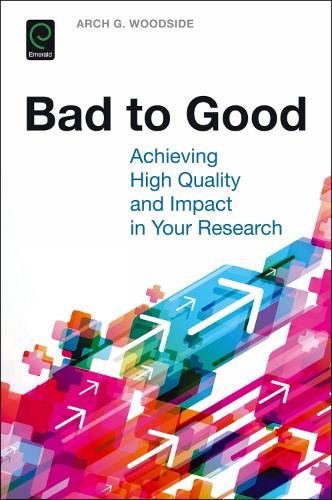
Bad to Good :Achieving High Quality and Impact in Your Research
paperback
Published:
25 August, 2016

Popular Books by Arch G. Woodside
View All Books by Arch G. Woodside

Description
More Details
| Type | Book |
|---|---|
| ISBN13 | 9781786353344 |
| ISBN10 | 1786353342 |
| Number Of Pages | 320 |
| Item Weight | 472 g |
| Product Dimensions | 152 x 229 x 14 mm |
| Publisher / Reseller | Emerald Publishing Limited |
| Format | paperback |
Media Reviews
Business scholars describe the bad research practices that are taught in courses and promulgated in most articles in most scholarly journals of finance, management, marketing, and organizational studies. They cover moving away from bad practices in research toward constructing useful theory and doing useful research; embrace complexity theory, perform contrarian case analysis, and model multiple realities; moving beyond multiple regression analysis and symmetric test to algorithms and asymmetric tests; case-based modeling of business-business relationships; performing triple sensemaking in field experiments; complexity theory, configural analysis, and deepening the service dominant logic; and complexity theory and human resources management: transcending variable and case-based perspective of service employees' (un)happiness and work performance. -- Annotation * (protoview.com) *
Author's Bio
Edited by Arch G. Woodside, Boston College, Chestnut Hill, MA, USA