
1.09Kg of CO2

136 litre(s) of Water

0.0082 Tree(s)

1 book donated to global literacy projects
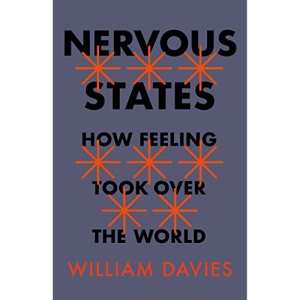
Nervous States :How Feeling Took Over the World
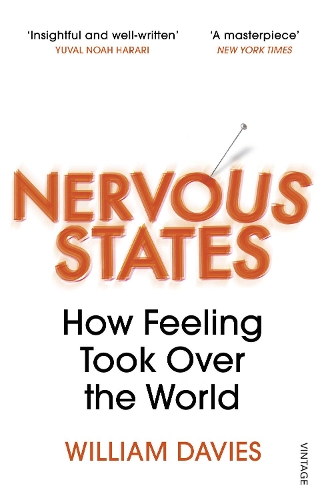
Nervous States :How Feeling Took Over the World
paperback
Published:
19 September, 2019


Popular Books by William Davies
View All Books by William Davies



Description
A dazzlingly original analysis of how emotions shape the times we are living in by one of Britain’s most exciting thinkers
‘A masterpiece’ New York Times
‘Insightful and well-written’ Yuval Noah Harari, author of Sapiens
How have feelings come to shape the world around us? Why has politics become so fractious and warlike? What might the future hold?
In this bold and compelling exploration of our new political reality, William Davies reveals how feelings have come to reshape our world. Drawing on history, philosophy, psychology and economics, Nervous States is an essential guide to the turbulent times we are living through.
More Details
| Type | Book |
|---|---|
| ISBN13 | 9781784707033 |
| ISBN10 | 1784707031 |
| Number Of Pages | 272 |
| Item Weight | 191 g |
| Product Dimensions | 129 x 198 x 17 mm |
| Publisher / Reseller | Vintage Publishing |
| Format | paperback |
Media Reviews
[An] interdisciplinary masterpiece. -- Mark Green * New York Times *
If you read one book about contemporary politics this year, make it this one. William Davies is as acute and accurate on the shifts we are enduring as on the deep roots behind contemporary thinking (or not thinking, I should add). -- Stuart Kelly * Scotland on Sunday *
The roots of our current anxieties are traced in [Nervous States,] an absorbing book fizzing with ideas… Davies is a wonderfully alert and nimble guide and his absorbing and edgy book will help us feel our way to a better future. -- Suzanne Moore * Observer *
Wide-ranging yet brilliantly astute… Davies is a wild and surprising thinker who also happens to be an elegant writer — a wonderful and eminently readable combination. Nervous States covers 400 years of intellectual history, technological innovation and economic development, seamlessly weaving in such disparate intellects as Carl von Clausewitz, Friedrich von Hayek and Hannah Arendt. -- Jennifer Szalai * New York Times *
We should all read William Davies’s Nervous States, a concise, penetrating exploration of the role played by negative emotions in our recent politics and culture -- Johanna Thomas-Corr * Evening Standard, **Books of the Year** *
What makes Nervous States such a fascinating read... is that it is a slickly written and timely intervention in an era when feelings have undoubtedly become more powerful than facts. -- Ian O'Doherty * Irish Independent *
An insightful and well-written book that explores the deep roots of the current crisis of expertise. The scientific community has been founded on the basis of separating reason from feeling. But now science itself has exposed this separation as an untenable myth. So where do we go from here? -- Yuval Noah Harari
A useful guide to our times… Nervous States makes a compelling case for paying more attention to the role of feelings, alongside that of reason, in modern life. -- Julian Baggini * Financial Times *
These are sparkling insights… [Nervous States] is an ambitious book with plenty to commend it. -- David Runciman * Guardian Weekly, Book of the Week *
[Davies] offers a penetrating analysis of 21st-century politics and culture… A fresh, astute examination of current events and urgent challenges. * Kirkus Reviews *
GoodReads Reviews
Author's Bio
William Davies teaches political economy and sociology at Goldsmiths, University of London. His work explores the history of ideas, especially the history of economics, and how this helps us understand the present. He is the author of The Happiness Industry and The Limits of Neoliberalism, and regularly writes for the Guardian and London Review of Books.