
1.09Kg of CO2

136 litre(s) of Water

0.0082 Tree(s)

1 book donated to global literacy projects
Nervous States :How Feeling Took Over the World
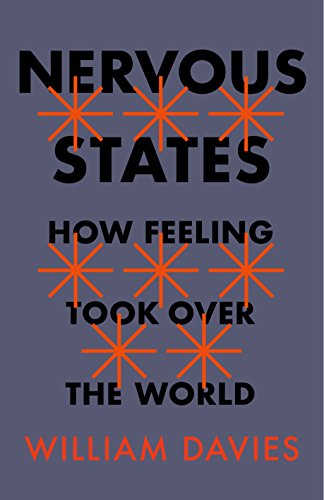
Nervous States :How Feeling Took Over the World
paperback
Published:
20 September, 2018


Popular Books by William Davies
View All Books by William Davies


Description
More Details
| Type | Book |
|---|---|
| ISBN13 | 9781787330115 |
| ISBN10 | 1787330117 |
| Number Of Pages | 272 |
| Item Weight | 334 g |
| Product Dimensions | 153 x 234 x 20 mm |
| Publisher / Reseller | Vintage Publishing |
| Format | paperback |
Media Reviews
"[An] interdisciplinary masterpiece." -- Mark Green * New York Times *
"If you read one book about contemporary politics this year, make it this one. William Davies is as acute and accurate on the shifts we are enduring as on the deep roots behind contemporary thinking (or not thinking, I should add)." -- Stuart Kelly * Scotland on Sunday *
"The roots of our current anxieties are traced in [Nervous States,] an absorbing book fizzing with ideas... Davies is a wonderfully alert and nimble guide and his absorbing and edgy book will help us feel our way to a better future. " -- Suzanne Moore * Observer *
"Wide-ranging yet brilliantly astute... Davies is a wild and surprising thinker who also happens to be an elegant writer - a wonderful and eminently readable combination. Nervous States covers 400 years of intellectual history, technological innovation and economic development, seamlessly weaving in such disparate intellects as Carl von Clausewitz, Friedrich von Hayek and Hannah Arendt." -- Jennifer Szalai * New York Times *
"We should all read William Davies's Nervous States, a concise, penetrating exploration of the role played by negative emotions in our recent politics and culture" -- Johanna Thomas-Corr * Evening Standard, **Books of the Year** *
GoodReads Reviews
Author's Bio
William Davies teaches political economy and sociology at Goldsmiths, University of London. His work explores the history of ideas, especially the history of economics, and how this helps us understand the present. He is the author of The Happiness Industry and The Limits of Neoliberalism, and regularly writes for the Guardian and the London Review of Books.