Political Disagreement :The Survival of Diverse Opinions within Communication Networks - Cambridge Studies in Public Opinion and Political Psychology
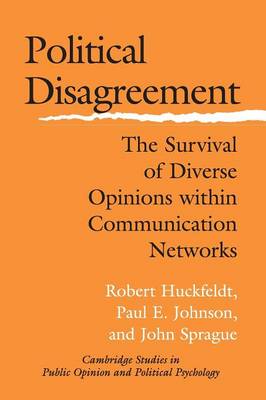
Political Disagreement :The Survival of Diverse Opinions within Communication Networks - Cambridge Studies in Public Opinion and Political Psychology
paperback
Published:
12 July, 2004

Popular Books by Robert Huckfeldt
View All Books by Robert Huckfeldt

Description
More Details
| Type | Book |
|---|---|
| ISBN13 | 9780521542234 |
| ISBN10 | 0521542235 |
| Number Of Pages | 274 |
| Item Weight | 410 g |
| Product Dimensions | 153 x 229 x 17 mm |
| Publisher / Reseller | Cambridge University Press |
| Format | paperback |
Media Reviews
'Political Disagreement discovers, in the contingencies of personal acquaintanceship, a foundation for democratic dissent. It is a work of the first order of originality, intellectual power, and importance.' Paul M. Sniderman, Stanford University
'A wonderful example of what social science can be … a well-articulated theory of how and why one's informal, face-to-face social networks are more diverse than social conformity and dissonance studies suggest. It then goes on to explain how this diversity helps citizens form and maintain their political beliefs and attitudes, and yes, even be persuaded. In a series of strong empirical tests, Huckfeldt demonstrates that from this diversity of opinion, citizens become capable of thinking more deeply about issues and - this a key point - develop tolerance for different points of view. Rarely do we see a better blend of theory informed empirical tests of important substantive and normative questions central to the conditions underlying a democratic citizenry.' Milton Lodge, Stony Brook University
Author's Bio
Robert Huckfeldt is Distinguished Professor of Political Science at the University of California, Davis. His interests lie in the areas of elections, public opinion, political communication, urban politics, and more generally in the relationships among groups and individuals in politics. He is the author of Dynamic Modeling (with Thomas Likens and Carol Weitzel Kohfeld, 1982), Politics in Context (2003), Race and the Decline of Class in American Politics (with Carol Weitzel Kohfeld, 1989) and Citizens, Politics, and Social Communication (with John Sprague, 1995). He has contributed articles to the American Political Science Review, The American Journal of Political Science, the Journal of Politics, the American Journal of Political Science, as well as other journals. Paul Johnson has published articles in the American Journal of Political Science, The Journal of Political Science, The Journal of Politics, The Journal of Theoretical Politics, Rationality and Society, The American Behavioral Scientist, and other journals. His articles include applications of game theory, social choice theory, and complexity theory. He currently has an avid interest in the development of tools for agent based modeling and computer simulation in the social sciences. He is the lead author of the Swarm User Guide, the manual that is distributed with the Swarm Simulation System. He is contributing to the development of Swarm and offers the Swarm FAQ as well as pre-packaged versions of Swarm for Linux users as well as several example programs. Professor Sprague has written on voting and elections, the history of socialist voting, voting patterns in the US Supreme Court, lawyers in politics, and crime including homicide. His academic career has been wholly at Washington University, St Louis, where he has been chair of the Department of Political Science. He is the author of Voting Patterns on the US Supreme Court (1969), Lawyers in Politics (with Heinz Eulau, 1984), The Dynamics of Riots (with Barbara Salert, 1980), Systems Analysis for Social Scientists (with Fernando Cortez and Adam Prseworski, 1974), Paper Stones: A History of Electoral Socialism (with Adam Przeworski, 1988) and Citizens, Politics, and Social Communication (with Robert Huckfeldt, Cambridge, 1995). He has contributed articles to the American Political Science Review, the Journal of Politics, the American Journal of Political Science, Political Methodology, Criminology, and other journals.