
1.2Kg of CO2

150 litre(s) of Water

0.009 Tree(s)

1 book donated to global literacy projects
Experts, Activists, and Democratic Politics :Are Electorates Self-Educating? - Cambridge Studies in Public Opinion and Political Psychology
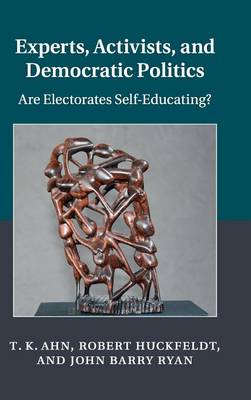
Experts, Activists, and Democratic Politics :Are Electorates Self-Educating? - Cambridge Studies in Public Opinion and Political Psychology
hardback
Published:
13 November, 2014


Popular Books by Robert Huckfeldt
View All Books by Robert Huckfeldt
Description
More Details
| Type | Book |
|---|---|
| ISBN13 | 9781107068872 |
| ISBN10 | 1107068878 |
| Number Of Pages | 300 |
| Item Weight | 590 g |
| Product Dimensions | 152 x 231 x 20 mm |
| Publisher / Reseller | Cambridge University Press |
| Format | hardback |
Media Reviews
'This is a landmark book that definitively demonstrates that political opinion formation is critically dependent on informal networks. The combination of experiments and decades of survey data not only makes the book a model of multi-methodological rigor, but also allows the authors to isolate the roots of expertise and opinion bias. This is a must-read for anyone interested in how democracies operate.' Jamie Druckman, Northwestern University
'A masterful, theory-based, experimentally grounded account of how and why the dissemination of political information in politically diverse and inherently biased networks leads citizens - especially those with weak interest and low knowledge - to support policies and candidates that may or may not be in accord with their own objectively defined interests. The primary movers in this process are the 'experts' and 'activists' in everyday life who are motivated both to become informed and to share their viewpoints with others. This is a major contribution to democratic theory accounting for how the arguments of opinion leaders come to permeate public discourse.' Milton Lodge, State University of New York, Stony Brook
'In its rigor and depth of insight into democratic politics, this is an unrivalled study of how citizens influence one another - and for just these reasons, a model of how political science can and should be done.' Paul Sniderman, Stanford University
'Against the onslaught of declarations that modern political life is isolated and anomic, this sparkling analysis of networks and experiments shows how networks of ideas and individuals connect our political activities. Ahn, Huckfeldt, and Ryan weave together network surveys and small group experiments to show how political ideas may spread in daily life as well as what structures enhance or restrict that spread. In the end, they present a very compelling vision of modern political life that encompasses politics in the current century, as well as the last half of the twentieth.' Michael Ward, Duke University
'This book reveals the ways in which pundits, partisans, and political activists are central to forming public opinion and to the resilience of democracy. These biased opinion leaders garner expertise in issues that interest them, and their views are channeled to citizens with little incentive to gather their own information. Anyone seeking to explain public opinion, opinion leaders, partisan bias, political activism, or political communication is going to have to tackle this book. Disputing its findings will be a herculean task. The authors marshal observational data, laboratory experiments, agent-based models, network analysis, and statistical simulations to support their central theoretical claims. The book is an excellent model of social science, using diverse methods to answer well-defined questions.' Rick K. Wilson, Rice University
Author's Bio
T. K. Ahn is an Associate Professor of Political Science at Seoul National University. His work has been published in a number of journals, including the American Journal of Political Science, the Journal of Politics, Political Psychology, the Journal of Public Economics, the Journal of Public Economic Theory, and the Journal of Economy Psychology. He has received the Paul Lazarsfeld Award from the American Political Science Association for the best paper on political communication. He received his PhD from Indiana University, Bloomington. Robert Huckfeldt is Distinguished Professor of Political Science at the University of California, Davis. He is the author or co-author of Politics in Context; Race and the Decline of Class in American Politics; Citizens, Politics, and Social Communication (Cambridge, 1995); Political Disagreement (Cambridge, 2004); Experts, Activists, and Interdependent Citizens; and a number of articles. He received the 1979 E. E. Schattschneider Award for outstanding dissertation in American politics from the American Political Science Association; the 2012 Doris Graber Outstanding Book Award from the Political Communication Section of the American Political Science Association; and outstanding conference-paper awards from the Political Communication Section and the Elections, Public Opinion, and Voting Section of the American Political Science Association. He received his PhD from Washington University, St Louis. John Barry Ryan is an Assistant Professor of Political Science at Florida State University. His work has appeared in journals such as the American Journal of Political Science, Political Behavior, and Political Communication. He has received the Paul Lazarsfeld Award from the American Political Science Association for the best paper on political communication. He received his PhD from the University of California, Davis.