Transformative Paleobotany :Papers to Commemorate the Life and Legacy of Thomas N. Taylor
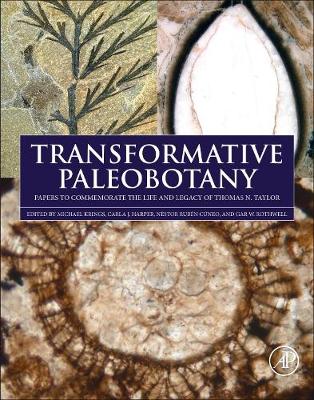
Transformative Paleobotany :Papers to Commemorate the Life and Legacy of Thomas N. Taylor
hardback
Published:
13 September, 2018

Popular Books by Munich
View All Books by Munich
Description
More Details
| Type | Book |
|---|---|
| ISBN13 | 9780128130124 |
| ISBN10 | 0128130121 |
| Number Of Pages | 732 |
| Item Weight | 2220 g |
| Publisher / Reseller | Elsevier Science Publishing Co Inc |
| Format | hardback |
Author's Bio
Michael Krings is curator for fossil plants at the Bavarian State Collection for Palaeontology and Geology (SNSB-BSPG) in Munich, Germany, and professor of plant paleobiology at the Ludwig-Maximilians-Universität Munich. He also holds an affiliate faculty position in the Department of Ecology and Evolutionary Biology at the University of Kansas. He received his PhD in botany from the University of Münster, Germany, and was an Alexander von Humboldt-Foundation postdoctoral fellow at the University of Kansas. His research interests include Carboniferous, Permian, and Triassic seed plants and the biology and ecology of microorganisms in late Paleozoic terrestrial ecosystems. Carla J. Harper is an Alexander von Humboldt-Foundation postdoctoral research fellow at the Bavarian State Collection for Palaeontology and Geology (SNSB-BSPG) and Ludwig- Maximilians-Universität Munich, Germany. She also holds a research associate position at the Biodiversity Institute and Natural History Museum at the University of Kansas. She received her Ph.D. in ecology and evolutionary biology from the University of Kansas. Her research interests include the biology and ecology of microorganisms and biotas in Permian–Jurassic ecosystems of Antarctica and late Paleozoic of Europe, symbiotic systems through time, as well as the biology, geochemistry, and evolution of fossil microbes. N. Ruben Cuneo is a Prinicipal Researcher at the National Research Council of Argentina, and Director of the Museo Paleontológico E. Feruglio in Trelew. He received his Ph.D. in Geology from the University of Buenos Aires. His research interests include fossil floras from Patagonia and Antarctica ranging from the Permian through the Eocene in aspects relatedwith their systematics, paleoecology, bio-chronostratigraphy and paleoclimatology. Gar Rothwell is the Edwin and Ruth Kennedy Distinguished Professor of Environmental and Plant Biology, Emeritus, Ohio University, and Courtesy Professor of Botany and Plant Pathology, Oregon State University. He is past-president of the International Organisation of Palaeobotany, author of the paleobotany textbook, Paleobotany and the Evolution of Plants (Stewart and Rothwell, 1993), and editor of six previous volumes of studies in plant paleontology. His research focuses on the role of development in evolution, and on the patterns of organismal evolution and phylogeny among land plants, particularly lycophytes, equisetophytes, ferns, and seed plants.