Einstein in Oxford
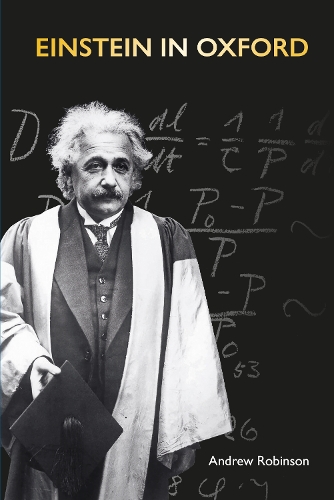
Einstein in Oxford
hardback
Published:
12 September, 2024

Popular Books by Andrew Robinson
View All Books by Andrew Robinson
Description
Nevertheless, he came back to Oxford in 1932 and again in 1933 – now as a refugee from Nazi Germany. In many ways, the city appealed deeply and revealed him at his most charismatic, as he participated in its science, music and politics, and wandered its streets alone. While staying in college rooms once occupied by the mathematician and writer Lewis Carroll, author of Alice’s Adventures in Wonderland, he wrote a rhymed German poem – now kept in the Bodleian Library – describing himself as an old ‘hermit’ and a roaming ‘barbarian’. His diary entries, alongside observations from the people he met – such as the future novelist William Golding – also reveal his unique sense of humour.
Einstein and 1930s Oxford were exquisitely matched and ill-matched, as the intimate and unfamiliar stories in this book reveal, thereby casting light on why Einstein continues to be the world’s most famous scientist.
More Details
| Type | Book |
|---|---|
| ISBN13 | 9781851246380 |
| ISBN10 | 185124638X |
| Number Of Pages | 96 |
| Item Weight | 666 g |
| Publisher / Reseller | Bodleian Library |
| Format | hardback |
Media Reviews
‘In Oxford the dons greeted Einstein with an esteem bordering on deification but were mostly bamboozled by relativity. Andrew Robinson’s masterful treatment reveals that Oxford’s colourful idiosyncrasies made a strong impression on Einstein in contrast with his meagre view of the university’s physical scientists.’
-- Roger Davies, Emeritus Professor of Astrophysics at the University of Oxford, and Student of Christ Church College, Oxford"England has always produced the best physicists," Albert Einstein once said in Berlin in 1925. His high regard for British physics led him to pay three visits to the University of Oxford in the early 1930s, which are described by Andrew Robinson in his charming short book Einstein in Oxford.
-- James Dacey * Physics World *Author's Bio
Andrew Robinson has written some twenty-five books, including two on Albert Einstein, as well as articles and reviews on Einstein for leading magazines and newspapers, and also Genius: A Very Short Introduction