
0.7Kg of CO2

88 litre(s) of Water

0.0053 Tree(s)

1 book donated to global literacy projects
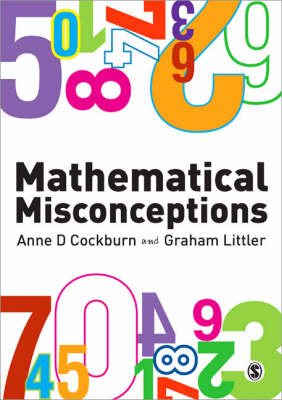
Mathematical Misconceptions :A Guide for Primary Teachers
Mathematical Misconceptions :A Guide for Primary Teachers
paperback
Published:
19 November, 2008


Popular Books by Anne Cockburn
View All Books by Anne Cockburn
Description
With contributors comprised of teachers, teacher educators, mathematicians and psychologists, Mathematical Misconceptions brings together information about pupils′ work from four different countries, and looks at how children, from the ages of 3 - 11, think about numbers and use them. It explores the reasons for their successes, misunderstandings and misconceptions, while also broadening the reader′s own mathematical knowledge. Chapters explore:
- the seemingly paradoxical number zero
- the concept of equality
- children′s perceptions and misconceptions of adding, subtracting, multiplying and dividing
- the learning process
- the ways in which children acquire number concepts.
This unique book will transform the way in which primary school teachers think about mathematics. Fascinating reading for anyone working with children of this age, it will be of particular interest to teachers, trainee teachers and teaching assistants. It will show them how to engage children in the mysteries and delights of numbers.
More Details
| Type | Book |
|---|---|
| ISBN13 | 9781847874412 |
| ISBN10 | 184787441X |
| Number Of Pages | 176 |
| Item Weight | 310 g |
| Publisher / Reseller | SAGE Publications Ltd |
| Format | paperback |
Media Reviews
′This book is a really interesting and useful volume...Each chapter has many questions, helpfully highlighted in boxes, so that the reader has the opportunity to pause and reflect. For me these questions turn this book from being good to excellent. Encouragingme to take the time to think about my own practice helps this book ask difficult but interesting questions. [It] is clearly aimed at primary teachers but I′m sure that secondary teachers would benefit hugely from this as well...I′m sure it will prompt useful and interesting discussions′ -
Association of Teachers of Mathematics
′As a secondary teacher of mathematics I′ve found this a remarkable insight into the student′s thinking - giving me clear background information to help me think about my classes and their misconceptions and how I could help the children develop their thinking′ -
Association of Teachers of Mathematics
′This book is a really interesting and useful volume...Each chapter has many questions, helpfully highlighted in boxes, so that the reader has the opportunity to pause and reflect. For me these questions turn this book from being good to excellent. Encouragingme to take the time to think about my own practice helps this book ask difficult but interesting questions. [It] is clearly aimed at primary teachers but I′m sure that secondary teachers would benefit hugely from this as well...I′m sure it will prompt useful and interesting discussions′ -
Association of Teachers of Mathematics
′As a secondary teacher of mathematics I′ve found this a remarkable insight into the student′s thinking - giving me clear background information to help me think about my classes and their misconceptions and how I could help the children develop their thinking′ -
Association of Teachers of Mathematics
GoodReads Reviews
Author's Bio
Anne D. Cockburn is a Professor Emeritus in Early Years Education at the University of East Anglia (UEA). She was educated in Edinburgh before reading Psychology at the University of St Andrews. Subsequently, she trained to be a primary teacher and taught in Scotland. In 1979, she became a Research Fellow at the University of Lancaster, working with Neville Bennett and Charles Desforges. Her PhD was completed in 1986 at the UEA. Following a period of working as a researcher, she took up her first lectureship at UEA in 1989. She became an Associate Fellow of the British Psychological Society in 1994. Initially Anne′s teaching focused on pre-service teacher education (BA and PGCE), gradually extending to in-service courses (BPhil and MA) and research (PhD and EdD). Throughout, she continued with her own research, with many of the catalysts for her investigations stemming from the needs and interests of professional practitioners and those with whom they work. More recently, she also started working with MA counselling students. Anne has examined doctoral theses, undergraduate and postgraduate courses at universities across the United Kingdom, Australia and Norway. She was a member of the Economic and Social Research Council Board of Examiners for studentships (2002–2005).