When you buy a used copy YOU SAVE

1.4Kg of CO2

175 litre(s) of Water

0.0105 Tree(s)

1 book donated to global literacy projects
Why Govern? :Rethinking Demand and Progress in Global Governance
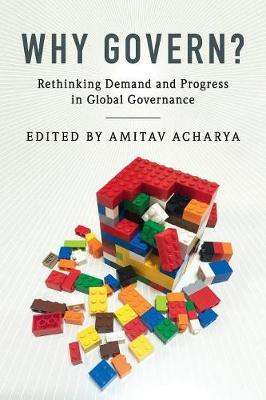
Why Govern? :Rethinking Demand and Progress in Global Governance
paperback
Published:
22 August, 2016
paperback
Published:
22 August, 2016

Standard worldwide delivery by
Mon, July 13 - Thu, July 16
Order within
0

Condition:
USED
$15.35
RRP
$42.53
You save $27.18 (64%)
Available
1
in stock
FREE Returns within 30 days
Popular Books by Amitav Acharya
View All Books by Amitav Acharya

Description
The system of international cooperation built after World War II around the UN is facing unprecedented challenges. Globalization has magnified the impact of security threats, human rights abuses, mass atrocities, climate change, refugee, trade and financial flows, pandemics and cyberspace traffic. No single nation, however powerful, can solve them on its own. International cooperation is necessary, yet difficult to build and sustain. Rising powers such as China, India, and Brazil seek greater leadership in international institutions, whose authority and legitimacy are also challenged by a growing number of civil society networks, private entities, and other non-state actors. Against this backdrop, what is the future of global governance? In this book, a group of the leading scholars in the field provide a detailed analysis of the challenges and opportunities facing global cooperation. The book offers a comprehensive and authoritative guide for scholars and practitioners interested in multilateralism and global order.
More Details
| Type | Book |
|---|---|
| ISBN13 | 9781316621813 |
| ISBN10 | 1316621812 |
| Number Of Pages | 350 |
| Item Weight | 500 g |
| Product Dimensions | 153 x 228 x 18 mm |
| Publisher / Reseller | Cambridge University Press |
| Format | paperback |
See More +
Author's Bio
Amitav Acharya is the UNESCO Chair in Transnational Challenges and Governance, School of International Service, American University, Washington DC. His recent publications include The End of American World Order (2014), Rethinking Power, Institutions and Ideas in World Politics: Whose IR? (2013), and Whose Ideas Matter: Agency and Power in Asian Regionalism (2009).