Why Bother? :Rethinking Participation in Elections and Protests - Cambridge Studies in Comparative Politics
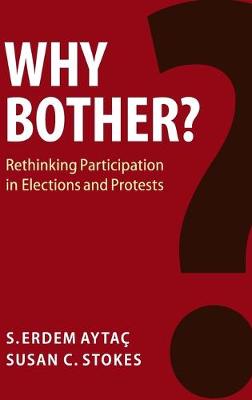
Why Bother? :Rethinking Participation in Elections and Protests - Cambridge Studies in Comparative Politics
hardback
Published:
10 January, 2019

Popular Books by Susan C. Stokes
View All Books by Susan C. Stokes



Description
More Details
| Type | Book |
|---|---|
| ISBN13 | 9781108475228 |
| ISBN10 | 1108475221 |
| Number Of Pages | 172 |
| Item Weight | 370 g |
| Product Dimensions | 157 x 236 x 14 mm |
| Publisher / Reseller | Cambridge University Press |
| Format | hardback |
Media Reviews
'Generations of scholars have puzzled over the reasons people vote and join protests. This book offers a unified theory supported by impressive evidence. Participation emerges, say S. Erdem Aytaç and Susan C. Stokes, through an individual's balancing of the burdens of taking part with those of staying away; and the competing burdens involve moral tensions as well as social pressures. Engagingly written throughout, Why Bother? is resoundingly successful for both its multidisciplinary synthesis and its fresh analysis.' Timur Kuran, Gorter Family Professor of Islamic Studies, Duke University, North Carolina
'This beautifully written book offers a simple theory to explain popular behavior in elections and protests. Aytaç and Stokes ask why people are sometimes not dissuaded from participation even when it becomes more difficult or dangerous. Why Bother? gives us hope that there are critical brakes on democratic backsliding. It comes at just the right moment.' Nicholas Valentino, University of Michigan
'It would be hard to overstate the importance of understanding the causal dynamics of political participation. And yet, despite massive social science investment in the topic, conventional theories in political science, sociology, and economics fail to explain empirical variation in participation. That's what makes Why Bother? so important. By taking seriously competing perspectives from different disciplines and attending to a range of real world cases, the authors have fashioned a compelling new theory of participation that promises to revolutionize our understanding of this most important political phenomenon.' Doug McAdam, Ray Lyman Wilbur Professor of Sociology, Stanford University, California
'The theoretical framework developed in this book gives students of political participation new tools to think about how these macrolevel factors influence individual decisions to vote and join protests … This book will undoubtedly become a classic in the political participation literature.' Miguel Carreras, Perspectives on Politics
Author's Bio
Selim Erdem Aytaç is an assistant professor in the Department of International Relations at Koç University in Istanbul, Turkey. He received his Ph.D. in political science from Yale University in 2014. Aytaç's research interests lie in political behavior with a focus on democratic accountability and political participation. His previous work has appeared in the Journal of Politics, Comparative Political Behavior, British Journal of Political Science, Political Behavior, and the Journal of Conflict Resolution, among other journals. He is the recipient of the 2016 Young Scientist Award of Science Academy (Turkey) and the 2018 Sakyp Sabancy International Research Award. Susan Stokes is the Tiffany and Margaret Blake Distinguished Service Professor of Political Science at the University of Chicago.