Brokers, Voters, and Clientelism - Cambridge Studies in Comparative Politics
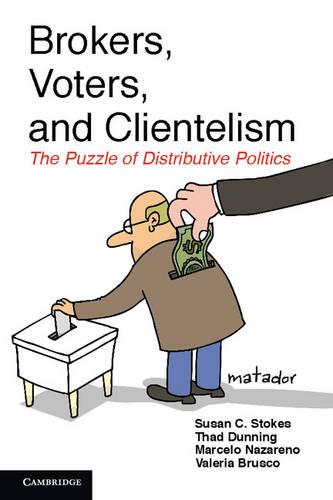
Brokers, Voters, and Clientelism - Cambridge Studies in Comparative Politics
hardback
Published:
23 September, 2013

Popular Books by Susan C. Stokes
View All Books by Susan C. Stokes
Description
Prizes
Winner of Luebbert Best Book Award, Comparative Politics Section, American Political Science Association 2014,Joint winner of Best Book Award, Comparative Democratization Section, American Political Science Association 2014
More Details
| Type | Book |
|---|---|
| ISBN13 | 9781107042209 |
| ISBN10 | 1107042208 |
| Number Of Pages | 344 |
| Item Weight | 600 g |
| Product Dimensions | 157 x 235 x 23 mm |
| Publisher / Reseller | Cambridge University Press |
| Format | hardback |
Media Reviews
'This book advances a single broad theoretical point: vote brokers are central to any system of vote buying in mass elections. While many previous scholars have considered the role of vote brokers from one angle or another, what sets this book apart is that it provides a unified theoretical model of vote brokers. It is grounded effectively in the modern economic theory of agency, and the authors run it through a series of tests using both original primary and secondary sources. Brokers, Voters, and Clientelism will be a landmark for the next generation of studies.' Gary W. Cox, Stanford University
'Brokers deserves every bit of attention it will garner … Brokers, Voters, and Clientelism is a model of theoretical precision, conceptual clarity, and impeccable logical reasoning, and its measured inferences, which are supported by exhaustive, careful empirical work, are placed within a proud tradition pioneered by V. O. Key, David Mayhew, Edward Banfield and other intellectual giants who young scholars often do not take the time to read.' Frances Hagopian, Perspectives on Politics
Author's Bio
Susan Stokes is John S. Saden Professor of Political Science at Yale University and Director of the Yale Program on Democracy. She is a member of the American Academy of Arts and Sciences, a past vice president of the American Political Science Association (APSA), and a past president of APSA's Comparative Politics Section. Her books and articles explore democratization and how democracy works in developing countries. They have been recognized with prizes from APSA, APSA's Comparative Democratization Section, and the Society for Comparative Research. Her research has been supported by grants and fellowships from the National Science Foundation, the Guggenheim Memorial Foundation, the Russell Sage Foundation, the American Philosophical Society, the MacArthur Foundation, and Fulbright programs. Thad Dunning is Professor of Political Science at Yale University. He is also a research fellow at Yale's Whitney and Betty MacMillan Center for International and Area Studies and at the Institution for Social and Policy Studies, and co-director, with Giovanni Maggi, of Yale's Leitner Program in International and Comparative Political Economy. He studies comparative politics, political economy, and methodology. His first book, Crude Democracy: Natural Resource Wealth and Political Regimes (Cambridge, 2008), won the Best Book Award from the Comparative Democratization Section of APSA and the Gaddis Smith Prize for the best first book on an international topic by a member of the Yale faculty. Dunning has also written on a range of methodological topics; his second book, Natural Experiments in the Social Sciences: A Design-Based Approach (Cambridge, 2012), develops a framework for the discovery, analysis, and evaluation of strong research designs. Marcelo Nazareno is Professor of Political Science at the National University of Córdoba and Professor of Methodology and Public Policy at the Catholic University of Córdoba. He holds a PhD in social science as well as advanced degrees in public administration and in history. He has been a visiting researcher at Yale University and the University of Chicago. His publications, in journals such as Desarrollo Económico and the Latin American Research Review, touch on the themes of the left in Latin America, clientelism and distributive politics, and fiscal federalism. He has made presentations on these topics at international conferences in Argentina, Brazil, the United States, and Spain. Valeria Brusco holds a master's degree in international relations and is completing her doctoral dissertation at the National University of San Martín in Buenos Aires. She is interested in how organizational agents, whether in political parties or in non-governmental organizations, deal with poverty, and has published articles on this topic as well as on competitive clientelism. She teaches at the National University of Córdoba and at the Catholic University of Córdoba, Argentina. She has studied and held research fellowships at the University of Georgia, Yale University, and Brown University. Brusco has also held office in the municipal council of the city of Córdoba, and is active in party politics in Argentina.