How Social Movements Die :Repression and Demobilization of the Republic of New Africa - Cambridge Studies in Contentious Politics
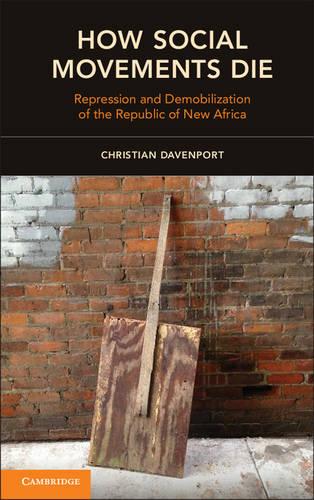
How Social Movements Die :Repression and Demobilization of the Republic of New Africa - Cambridge Studies in Contentious Politics
paperback
Published:
22 December, 2014

Popular Books by Christian Davenport
View All Books by Christian Davenport




Description
More Details
| Type | Book |
|---|---|
| ISBN13 | 9781107613874 |
| ISBN10 | 1107613876 |
| Number Of Pages | 352 |
| Item Weight | 490 g |
| Product Dimensions | 153 x 230 x 20 mm |
| Publisher / Reseller | Cambridge University Press |
| Format | paperback |
Media Reviews
'Marshalling insightful analysis, brilliant archival research, and extensive knowledge, Davenport explains the emergence, growth, and demise of social movements. This book is a real gem.' Scott Gates, Peace Research Institute Oslo and Norwegian University of Science and Technology
'Through a meticulous analysis of a single case - the Republic of New Africa - Christian Davenport presents us with new theoretical insights into the external forces and internal dynamics that can eventually lead to the demise of a social movement organization that at its inception was at the forefront of a broader movement. His analysis of archival information on both overt and covert forms of state repression as well as his scrupulous analysis of RNA internal documents present us with innovative methods and novel lessons for the study of how social movement organizations emerge and eventually die.' T. David Mason, University of North Texas
'Through a fascinating case study of the Republic of New Africa, Christian Davenport brings his expertise on political repression to bear on a question that has, oddly, been largely neglected by scholars: how and why do social movements die? Drawing on unusually rich data that take us inside the thought processes of movement actors as well as their opponents, Davenport offers deep insight into both the rise and demise of social movement organizations.' Rory McVeigh, University of Notre Dame
'There is a great deal to admire about this book from its astonishingly rich data and thorough analysis to its clear theorizing about an important and nettlesome issue in the study of repression (What are the consequences of repression?) to its call for research on demobilization.' American Journal of Sociology
'… the book will be useful for scholars interested in demobilization of social movement organizations or the general impact of state repression on movements, organizations, and individuals.' Ahsan Kamal, Oxford University Press Journals: Social Forces
Author's Bio
Christian Davenport is Professor of Political Science and Faculty Associate at the Center for Political Studies at the University of Michigan, as well as Global Fellow at the Peace Research Institute Oslo. He is the author of State Repression and the Promise of Democratic Peace (Cambridge, 2007) and Media Bias, Perspective and State Repression: The Black Panther Party (Cambridge, 2010), which won an award for the best book in racial politics and social movements from the American Political Science Association. He is the editor of Repression and Mobilization, with Carol Mueller and Hank Johnston (2004), and Paths to State Repression: Human Rights Violations and Contentious Politics (2000).