When you buy a used copy YOU SAVE

0.53Kg of CO2

66 litre(s) of Water

0.004 Tree(s)

1 book donated to global literacy projects
Changing the Way We Work
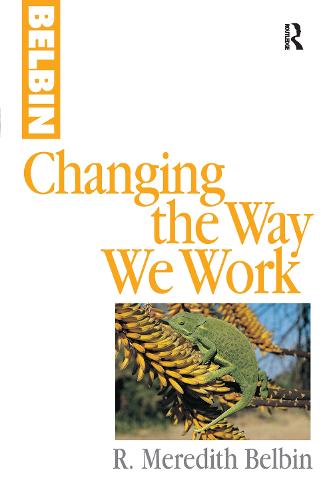
Changing the Way We Work
paperback
Published:
24 September, 1999
paperback
Published:
24 September, 1999

Standard worldwide delivery by
Thu, June 18 - Tue, June 23
Order within
0

Condition:
USED
$8.58
RRP
$78.69
You save $70.12 (89%)
Available
1
in stock
FREE Returns within 30 days
Popular Books by R Meredith Belbin
View All Books by R Meredith Belbin
Description
How many problems at work arise from the way in which jobs are set up? Either people don't have a clear understanding of their duties and responsibilities, spending time and energy disentangling them from those of their co-workers or they are hemmed in by job specifications that allow no room for movement and initiative. An alternative system is needed, where jobs can grow and develop: where communication about the work can flow up as easily as down. Dr Belbin describes a radical approach incorporating colour-coding and information technology derived from experiments now being undertaken in three countries. Workset is a new means of delivering greater efficiency in a dynamic process that equally involves managers and jobholders. Dr R. Meredith Belbin, regarded as the father of team-role theory for his widely-read Management Teams: Why they succeed or fail and its successor Team Roles at Work, obtained his first and higher degree at Cambridge University. Later, in a research, lecturing or consulting capacity, he has visited and worked in many countries. In 1988 he founded Belbin Associates which produces Interplace, a computer-based Human Resource Management System, now used world-wide.
More Details
| Type | Book |
|---|---|
| ISBN13 | 9780750642880 |
| ISBN10 | 0750642882 |
| Number Of Pages | 132 |
| Item Weight | 240 g |
| Publisher / Reseller | Taylor & Francis Ltd |
| Format | paperback |
See More +
Media Reviews
Review of The Coming Shape of Organization 'A new book from the father of team-role theory is an event....this stimulating, brief analysis suggesting that an effective model for the new flatter organization may be a helix, in which individuals and teams move forward on the basis of excellence rather than function.' The Director, July 1996