Organizational Report Cards
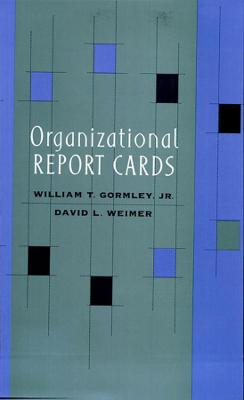
Organizational Report Cards
hardback
Published:
31 March, 1999

Popular Books by William T. Gormley
View All Books by William T. Gormley
Description
In recent years, consumers, professional organizations, government officials, and third-party payers have become increasingly concerned about how to assess the quality of the services provided by organizations in both the private and the public sectors. One new approach is the organizational report card, which compares the performance of organizations such as public schools, colleges, hospitals, and HMOs.
This book offers the first comprehensive study of such instruments. It discusses the circumstances under which they are desirable alternatives to other policy instruments, such as regulation; how they should be designed; who is likely to use them and for what purpose; and what role, if any, government should have in their creation. Informed by cases drawn from education, health, and other policy areas, this book develops a conceptual framework for analyzing these issues. It explores the tradeoffs in measuring performance, the methods of communicating results effectively to mass and elite audiences, and the ways in which organizations respond to the data gathered.
Prizes
Nominated for Aaron Wildavsky Enduring Contribution Award 2001
More Details
| Type | Book |
|---|---|
| ISBN13 | 9780674643505 |
| ISBN10 | 067464350X |
| Number Of Pages | 288 |
| Item Weight | 553 g |
| Publisher / Reseller | Harvard University Press |
| Format | hardback |
Media Reviews
Political scientists Gormley and Weimer offer an insightful and well-written account of an increasingly popular policy tool they refer to as the ‘organizational report card.’ As they conceive it, the ‘organizational report card’ is a policy instrument that enhances accountability by providing performance measurements of public and private sector organizations. After elaborating the rationale and history of organizational report cards, the authors consider the methodological challenges associated with designing such instruments… This thoughtful book will be of special value to those interested in policy studies and public administration. Highly recommended for graduate students and faculty as well as practitioners/professionals. -- G. L. Malecha * Choice *
In this era of expanding consumer choice, greater diversity among suppliers, and concerns about the quality and cost of services, it is not surprising that report cards on organizations are proliferating in policy areas such as education and health care. But with what effects and at what cost? What makes some report cards productive and others harmful? For answers to these and related questions, read this authoritative and comprehensive book on an intriguing and controversial new policy instrument—the provision of comparative information and rankings on the effectiveness of organizations. -- Helen F. Ladd, Sanford Institute of Public Policy, Duke University
In the continuing effort to achieve greater accountability and performance from public sector enterprises, organizational scorecards—systems of measurements that compare similar organizations on key dimensions of performance—have emerged as important policy tools. Gormley and Weimer have done an excellent job of explaining how, and why, and under what circumstances this powerful tool can actually work to improve the performance of both governmental and nonprofit organizations. Since finding effective ways to use measurement to drive the performance of public organizations is key to effectively managing them, this book is a must read for governmental and nonprofit managers. -- Mark H. Moore, Director, Hauser Center on Non-Profit Organizations, Kennedy School of Government
As organizational report cards have become increasingly common across the public sector, we need to understand their strengths and weaknesses as policy tools. Gormley and Weimer’s wonderful book reveals how complicated it is to assess the consequences of making and using a report card for public purposes. Their careful, intelligent analysis shows how this apparently simple, rational tool engages layer upon layer of response, with important implications for the report card writers, the organizations being graded, the public, and the democratic process. -- Janet A. Weiss, University of Michigan School of Business and School of Public Policy
Author's Bio
William T. Gormley, Jr., is Professor of Government and Public Policy, Georgetown University. David L. Weimer is Professor of Public Policy and Political Science, University of Rochester.