
0.99Kg of CO2

124 litre(s) of Water

0.0074 Tree(s)

1 book donated to global literacy projects
Einstein’s Greatest Blunder? :The Cosmological Constant and Other Fudge Factors in the Physics of the Universe - Questions of Science
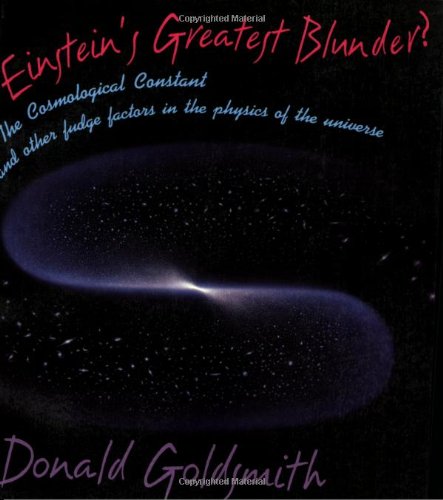
Einstein’s Greatest Blunder? :The Cosmological Constant and Other Fudge Factors in the Physics of the Universe - Questions of Science
paperback
Published:
14 November, 1997


Popular Books by Donald Goldsmith
View All Books by Donald Goldsmith


Description
The Big Bang: A Big Bust? The cosmos seems to be in crisis, and you don’t have to be a rocket scientist to see it. How, for instance, can the universe be full of stars far older than itself? How could space have once expanded faster than the speed of light? How can most of the matter in the universe be “missing”? And what kind of truly weird matter could possibly account for ninety percent of the universe’s total mass?
This brief and witty book, by the award-winning science writer Donald Goldsmith, takes on these and other key questions about the origin and evolution of the cosmos. By clearly laying out what we currently know about the universe as a whole, Goldsmith lets us see firsthand, and judge for ourselves, whether modern cosmology is in a state of crisis. Einstein’s Greatest Blunder? puts the biggest subject of all—the story of the universe as scientists understand it—within the grasp of English-speaking earthlings.
When Albert Einstein confronted a cosmological contradiction, in 1917, his solution was to introduce a new term, the “cosmological constant.” For a time, this mathematical invention solved discrepancies between his model and the best observations available, but years later Einstein called it the “greatest blunder” of his career. And yet the cosmological constant is still alive today—it is one of the “fudge factors” employed by cosmologists to make their calculations fit the observational data. Theoretical cosmologists, shows Goldsmith, continually reshape their models in an honest (if sometimes futile) effort to explain apparent chaos as cosmic harmony—whether their specific concern is the age and expansion rate of the cosmos, hot versus cold “dark matter,” the inflationary theory of the big bang, the explanation of large-scale structure, or the density and future of the universe.
Engagingly written and richly illustrated with photographs taken by the Hubble Space Telescope, Einstein’s Greatest Blunder? is a feast for the eye and mind.
More Details
| Type | Book |
|---|---|
| ISBN13 | 9780674242425 |
| ISBN10 | 0674242424 |
| Number Of Pages | 248 |
| Item Weight | 408 g |
| Product Dimensions | 178 x 203 x 20 mm |
| Publisher / Reseller | Harvard University Press |
| Format | paperback |
Media Reviews
It is not until you are well into the middle of the book, enthralled by galaxies and looking forward to the mystery of the missing mass, that you realize that you have been absorbed and that everybody else has gone to bed. Here is a first-class work, one of the best accounts of the successes of intellectual curiosity and observation about the universe and of how much more there is to find out. Exciting stuff. -- Roy Herbert * New Scientist *
Donald Goldsmith is one of the world's great astronomy writers, and he shows why in his new book...The cosmological constant skewed Einstein's equations and prevented him from foreseeing one of the grandest discoveries ever: The cosmos is expanding. Goldsmith discusses this and many other cosmological topics in his typically wry style. -- Keay Davidson * San Francisco Examiner *
[Goldsmith's] first eight chapters, which are enough to make the book worthwhile, trace the development of astronomy from Copernicus to its modern form. The lucid text holds the readers' hand through four centuries of astronomy...Then Goldsmith delves into current conundrums in cosmology...Fascinating...Because of its lively account of the history and physics of astronomy, the book will stand as an engaging account of what astronomers do and how the universe works--as far as we know. -- Katherine M. Reynolds * Boston Book Review *
For those seeking to know more about what scientists today think about the universe and why they think it, this well-illustrated book is an excellent place to start. -- Robert W. Smith * Air & Space *
A witty and succinct work on the problems of modern cosmology...In a rapidly changing field, this book captures the excitement and uncertainty of the science. * Choice *
Goldsmith...tells us about the problems that cosmology is having thanks to the numerous discoveries made by the latest astronomical satellites...These contradictions usually find a fast reflection in the press and other broadcasting media, yet they are rarely treated in a coherent, precise way. Goldsmith not only makes us realise what appears to be not quite all right, but also he explains why and what could be, in some cases, the solution to the problem. Being an expert science writer, the author makes a wonderful job, while showing us everything we need to know about the question with great clarity. * The Space Book Board (Barcelona-based web site) *
GoodReads Reviews
Author's Bio
Donald Goldsmith has written more than a dozen books, including Exoplanets, The Runaway Universe, The Hunt for Life on Mars, Supernova, and, with Neil deGrasse Tyson, Origins. He has received lifetime achievement awards for astronomy education from the American Astronomical Society and for the popularization of astronomy from the Astronomical Society of the Pacific.