The Physics of Information Technology - Cambridge Series on Information and the Natural Sciences
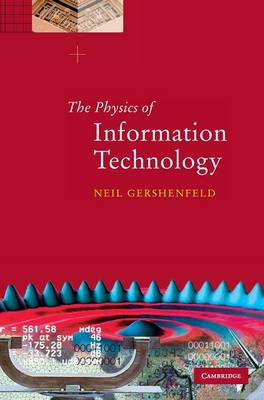
The Physics of Information Technology - Cambridge Series on Information and the Natural Sciences
hardback
Published:
16 October, 2000
hardback
Published:
16 October, 2000

Standard worldwide delivery by
Tue, July 28 - Fri, July 31
Order within
0
Popular Books by Neil Gershenfeld
View All Books by Neil Gershenfeld
Description
The Physics of Information Technology explores the familiar devices that we use to collect, transform, transmit, and interact with electronic information. Many such devices operate surprisingly close to very many fundamental physical limits. Understanding how such devices work, and how they can (and cannot) be improved, requires deep insight into the character of physical law as well as engineering practice. The book starts with an introduction to units, forces, and the probabilistic foundations of noise and signalling, then progresses through the electromagnetics of wired and wireless communications, and the quantum mechanics of electronic, optical, and magnetic materials, to discussions of mechanisms for computation, storage, sensing, and display. This self-contained volume will help both physical scientists and computer scientists see beyond the conventional division between hardware and software to understand the implications of physical theory for information manipulation.
More Details
| Type | Book |
|---|---|
| ISBN13 | 9780521580441 |
| ISBN10 | 0521580447 |
| Number Of Pages | 388 |
| Item Weight | 878 g |
| Product Dimensions | 181 x 255 x 29 mm |
| Publisher / Reseller | Cambridge University Press |
| Format | hardback |
See More +
Media Reviews
Review of the hardback: 'Gershenfeld's book will be valuable for physical scientists looking for an enjoyable introduction to the information sciences.' Science
Review of the hardback: 'The book is attractive for its presentation bringing together in a skillful way fundamentals of physics and technological devices … this book is very recommended for teaching the basics of electrical engineering and the simultaneous breath of coverage and conciseness is quite amazing.' Zentralblatt für Mathematik