Infants' Sense of People :Precursors to a Theory of Mind
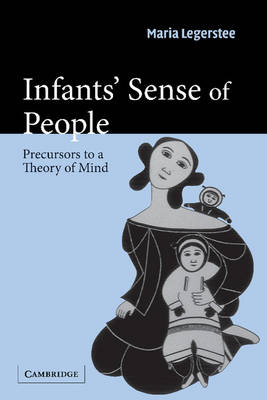
Infants' Sense of People :Precursors to a Theory of Mind
paperback
Published:
8 December, 2005
paperback
Published:
8 December, 2005

Standard worldwide delivery by
Thu, July 23 - Mon, August 3
Order within
0
Popular Books by Maria Legerstee
View All Books by Maria Legerstee
Description
Infants' Sense of People focusses on infants during their first year of life, exploring how they begin to think about other people, their feelings, emotions and intentions, and how they become aware of these aspects of their own development. Drawing on a broad range of research and developmental theory, Maria Legerstee takes the view that infants have an innate sense of people at birth, which is activated through sympathetic emotions. She questions the idea that infants use physical parameters such as contingencies or motion to distinguish people from objects, and rejects the assumption that infants are mechanical creatures before they become psychological ones. She argues persuasively that before infants learn to speak, interactions with others are possible because infants have a primitive pre-linguistic 'theory of mind'. This accessible book provides a valuable synthesis of current thinking on early social and cognitive development and the origins of theory of mind.
More Details
| Type | Book |
|---|---|
| ISBN13 | 9780521521697 |
| ISBN10 | 0521521696 |
| Number Of Pages | 240 |
| Item Weight | 360 g |
| Product Dimensions | 152 x 229 x 14 mm |
| Publisher / Reseller | Cambridge University Press |
| Format | paperback |
See More +
Media Reviews
'The book provides a valuable synthesis of current theoretical approaches and research on the roots of social and cognitive development in general, with a focus on children's Theory of Mind.' Pnina S. Klein, Bar-Ilan University, Israel
Author's Bio
Maria Legerstee is Professor of Psychology at York University, Toronto, where she established the Centre for Infancy Studies in 1991. She has published in journals of development psychology and child development.