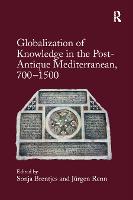
Globalization of Knowledge in the Post-Antique Mediterranean, 700-1500
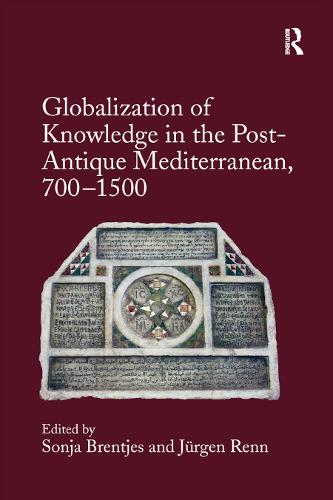
Globalization of Knowledge in the Post-Antique Mediterranean, 700-1500
paperback
Published:
30 June, 2020

Popular Books by Sonja Brentjes
View All Books by Sonja Brentjes
Description
More Details
| Type | Book |
|---|---|
| ISBN13 | 9780367879662 |
| ISBN10 | 0367879662 |
| Number Of Pages | 242 |
| Item Weight | 680 g |
| Publisher / Reseller | Taylor & Francis Ltd |
| Format | paperback |
Media Reviews
"The editors assume that after the disintegration of the Roman Empire the Mediterranean continued to be a highly integrated region. Despite a growing political, economic and cultural diversity people, artefacts, ideas and knowledge continued to move back and forth between the Mediterranean, the Arabian peninsula, the Indian subcontinent and central Asia… The focus of the contributions is on the circulation of scholarly knowledge and the forms of its transmission…Texts of this kind will expand our future knowledge of intercultural transfers and will increase the Mediterranean region's visibility as a zone of integration." H-Net Reviews; October 2016
"Globalization of Knowledge in the Post-Antique Mediterranean, 700–1500, offers a very interesting window into the ongoing debates sponsored by the Max Planck Institute for the History of Science. Furthermore, the volume is a representative collection of materials and methods involved in the study of knowledge, knowledge transfer, and globalization in the premodern world. It would be of benefit for anyone interested in the underlying mechanics of the globalization of knowledge: the routes, modes, and institutions involved in the transfer and transformation of knowledge." Shahrzad Irannejad, Isis Review
‘The editors assume that after the disintegration of the Roman Empire the Mediterranean continued to be a highly integrated region. Despite a growing political, economic and cultural diversity people, artefacts, ideas and knowledge continued to move back and forth between the Mediterranean, the Arabian peninsula, the Indian subcontinent and central Asia… The focus of the contributions is on the circulation of scholarly knowledge and the forms of its transmission…Texts of this kind will expand our future knowledge of intercultural transfers and will increase the Mediterranean region's visibility as a zone of integration.’ H-Net Reviews; October 2016
Author's Bio
Sonja Brentjes is researcher at the Max Planck Institute for the History of Science in Berlin and member of the International Academy for the History of Science in Paris. She studies the institutional and intellectual history of the sciences in past Islamicate societies (patronage, madrasas, translations, maps, sciences and the arts), cross-cultural encounters in Africa, western Asia and Europe and historiographical issues of the narration of the sciences in Islamicate societies in their relationship to antiquity, the Middle Ages and the early modern period. Jurgen Renn is Director at the Max Planck Institute for the History of Science in Berlin and Honorary Professor for History of Science at both the Humboldt-Universitat zu Berlin and the Freie Universitat Berlin. His research looks at structural changes in systems of knowledge with the aim of developing a theoretical understanding of knowledge evolution, taking into account its epistemic, social and material dimensions. As groundwork for such a theoretical approach to the history of knowledge, he studies some of the great transformations of systems of physical knowledge, such as the origin of theoretical science in antiquity, the emergence of classical mechanics in the early modern period and the revolutions of modern physics in the early twentieth century.