Chaucer’s Ethical Philosophy
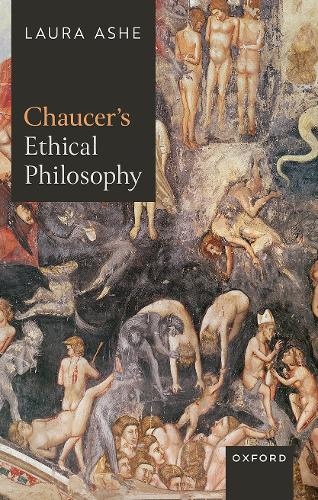
Chaucer’s Ethical Philosophy
hardback
Published:
4 February, 2025

Popular Books by Laura Ashe
View All Books by Laura Ashe
Description
More Details
| Type | Book |
|---|---|
| ISBN13 | 9780198894964 |
| ISBN10 | 0198894961 |
| Number Of Pages | 224 |
| Item Weight | 398 g |
| Product Dimensions | 145 x 223 x 20 mm |
| Publisher / Reseller | Oxford University Press |
| Format | hardback |
Media Reviews
Ashe gives us a Chaucer whose narratives are driven by ideas, who truly sees women as human beings, and who values human love in ways that reach beyond the norms of his time ... The prose style is passionate and charismatic throughout, and I found it refreshing to read scholarly work that dares to register an affective response to narratives of appalling suffering and dizzying joy. One achievement of this book is the way it gives readers permission to be moved by Chaucer's stories. Treating them as philosophical thought experiments does not, it turns out, attenuate their emotional resonance; on the contrary, this approach invites analogies to our own lived experiences as subjects navigating the world, such that Ashe's philosophical reading of Chaucer is also, and wonderfully, a personal one. * Megan Murton, Review of English Studies *
In this thoughtful and eloquent book, Laura Ashe establishes Chaucer's credentials as a moral philosopher. The argument is not that he wrote philosophical treatises, but rather that his fictions are imaginative "thought experiments" that explore the same big questions that have fascinated modern philosophers ... When sympathy with Chaucer's Christian beliefs can no longer be taken for granted, alternative philosophies are needed to make sense of Chaucer's ethics. Laura Ashe's book recognizes and satisfies that need. * Ad Putter, TLS *
Author's Bio
Laura Ashe is Professor of English Literature at the University of Oxford, and a fellow of Worcester College. An undergraduate at the University of Cambridge, she held a Kennedy Memorial Scholarship at Harvard University before returning to Cambridge for doctoral study. She was appointed Junior Research Fellow at Gonville & Caius College, Cambridge, and then Lecturer in English at Queen Mary, University of London, before coming to Oxford. She has published numerous books and articles, working on English and European literature, history, culture and ideas across the Middle Ages from the tenth to the seventeenth century.