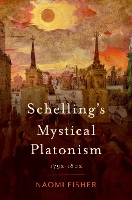
Schelling's Mystical Platonism :1792-1802

Schelling's Mystical Platonism

Schelling's Mystical Platonism :1792-1802

(Author)
hardback
Published: 23 September, 2024
Standard worldwide delivery by Thu, August 6 - Tue, August 11
Order within 0
Condition: NEW
$90.76
Price includes shipping
Available 20 in stock
- +
FREE Returns within 30 days

Description

Schelling came of age during the pivotal and exciting years at the end of the eighteenth century, as Kant's philosophy was being incorporated into the German academic world. At this time, in addition to delving into the new Kantian philosophy, Schelling engaged in an intense study of Plato's dialogues and was immersed in a Neoplatonic intellectual culture. Attention to these aspects of Schelling's early philosophical development illuminates his fundamental commitments. Throughout the first decade of his adult life, from 1792-1802, Schelling was a mystical Platonist. Naomi Fisher argues that Schelling is committed to two overarching theses, which together comprise his mystical Platonism. First, Schelling considers the absolute to be ineffable: It cannot be described in conceptual terms. For this reason, it remains inferentially external to any given philosophical system and is only intimated to us in certain analogical formulations, in works of art, or in nature as a whole. Second, Schelling is committed to a kind of priority monism: All things are grounded in the absolute, but finite things possess an integral unity all their own, and so have a distinct and relatively independent existence. Highlighting these commitments resolves an interpretive dispute, according to which Schelling is a Fichtean idealist or a Spinozist, or he vacillates between these positions. Interpreting Schelling as advancing a mystical Platonism provides an alternative way of interpreting these early texts, such that they are by and large consistent. Fisher presents Schelling's early philosophy as a unique and compelling fusion of the old and new: Schelling fulfills the characteristic aims of post-Kantian philosophy in a way distinctive among his contemporaries, by drawing on and appropriating various strands of Platonism.
See more

More Details

Type Book
ISBN13 9780197752883
ISBN10 0197752888
Number Of Pages 248
Item Weight 635 g
Product Dimensions 132 x 234 x 28 mm
Publisher / Reseller Oxford University Press Inc
Format hardback
See More +

Media Reviews

Naomi Fisher's Schelling's Mystical Platonism has at last given English-language scholarship a monument to F. W. J. Schelling's early Platonism to rival Werner Beierwaltes' work in German and Jean-Louis Vieillard-Baron's work in French... Fisher has decisively moved the debate on and produced definitive resources for a mature consideration of Schelling's Platonism in the English language. * Notre Dame Philosophical Reviews *
In her groundbreaking study Schelling's Mystical Platonism (1792–1802), Fisher maps out a compelling case for Schelling's use of Neoplatonic ideas, like geometric exhibition, that trace back to 'middle Platonism' (Philo, Plutarch, and Plato's Philebus). This well-researched study is sure to catalyze new approaches toward a significant but lesser-studied philosopher, who is essential for our understanding of German idealism... Summing Up: Highly recommended. General readers through faculty; professionals. * CHOICE *
..this book can be warmly commended to anyone interested in the fascinating legacy of Platonism in German Romanticism. * Paul Bishop, Modern Language Review *

Show more

Author's Bio

Naomi Fisher is Assistant Professor of Philosophy at Loyola University Chicago. She is a scholar of Kant and post-Kantian German philosophy, and she also holds an M.S. in physics. Her work focuses on notions of nature, freedom, and grounding in Kant and post-Kantian philosophy.

Show more