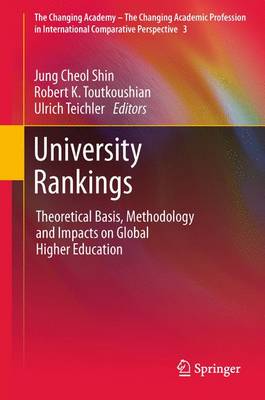
University Rankings :Theoretical Basis, Methodology and Impacts on Global Higher Education - The Changing Academy – The Changing Academic Profession in International Comparative Perspective
University Rankings :Theoretical Basis, Methodology and Impacts on Global Higher Education - The Changing Academy – The Changing Academic Profession in International Comparative Perspective
paperback
Published:
3 August, 2013

Popular Books by Ulrich Teichler
View All Books by Ulrich Teichler
Description
This ground-breaking and exhaustive analysis of university ranking surveys scrutinizes their theoretical bases, methodological issues, societal impact, and policy implications, providing readers with a deep understanding of these controversial comparators. The authors propose that university rankings are misused by policymakers and institutional leaders alike. They assert that these interested parties overlook the highly problematic internal logic of ranking methodologies even as they obsess over the surveys’ assessment of their status. The result is that institutions suffer from short-termism, realigning their resources to maximize their relative rankings. While rankings are widely used in policy and academic discussions, this is the first book to explore the theoretical and methodological issues of ranking itself. It is a welcome contribution to an often highly charged debate. Far from showing how to manipulate the system, this collection of work by key researchers aims to enlighten interested parties.
More Details
| Type | Book |
|---|---|
| ISBN13 | 9789400736443 |
| ISBN10 | 9400736444 |
| Number Of Pages | 274 |
| Item Weight | 1000 g |
| Publisher / Reseller | Springer |
| Format | paperback |
| Edition | 2011 ed. |
Media Reviews
“This is the best book going on university rankings. It provides a reliable, readable, wide-ranging guide for the policy maker, university leader, scholar and would be doctoral student who wants to make sense of the mass of ranking data now available. Shin, Toutkoushian and Teichler tell us how to sort the good, the bad and the ugly in university comparison. A strength of the book, one that guarantees its broad relevance, is the inclusion of contributions from each of the world’s major zones of higher education.”
Simon Marginson, Professor, University of Melbourne
“This volume makes an impressive contribution to our understanding of the international obsession with university rankings. Shin, Toutkoushian, and Teichler, along with their contributing authors, examine the topic from multiple perspectives that will appeal to administrators, scholars, and public audiences alike. Grounded in organizational theory, the volume sheds light on the many ranking methodologies ranging from simplistic and descriptive to intricate and multivariate. Not only do several chapters illuminate the relevant measurement issues, but other chapters address the social impact of the rankings themselves and how they influence university behavior. No other book combines such a rich collection of international perspectives and so effectively fills a gap in the literature.”
James Fredericks Volkwein, Professor, Pennsylvania State University
“This book offers a comprehensive and very timely analysis of a topic of central importance to contemporary higher education: university rankings. Contributors to the book provide a key to the understanding of the theoretical basis and methodological foundations of rankings and their impact on higher education systems and institutions. Illuminating the amazing popularity of rankings, broad and refreshing reflection on the drivers and consequences of rankings areoffered.”
Jürgen Enders, Professor, University of Twente
“Since the rankings and indicators of universities are proliferating, this book appears in due time for generating some overview of the field. Do the rankings measure efficiency (in terms of output/input) or effectiveness (in terms of stated goals)? Is one comparing apples with oranges? For example, since mathematicians provide fewer references than molecular biologists, would a university be well advised to close its mathematics department? Would Harvard still be at the top of the list if publications/dollar were used for the ranking? These and such questions require further reflection. The authors have done a commendable job in organizing the state of the art.”
Loet Leydesdorff, Professor, University of Amsterdam
…” Though not all aspects covered in the book are new, the 13 scholar—contributors to this book, make it a good reading on what is becoming an increasingly important issue, for the graduate students and policy‐makers as well.”
Jandhyala B.G. Tilak, National University of Educational Planning and Administration, New Delhi, IndiaJournal of Educational Planning and Administration
Volume XXVII, No. 2, April 2013, pp. 209‐224
http://www.nuepa.org/Pub_Jepa.html