Forecasting International Migration in Europe: A Bayesian View - The Springer Series on Demographic Methods and Population Analysis
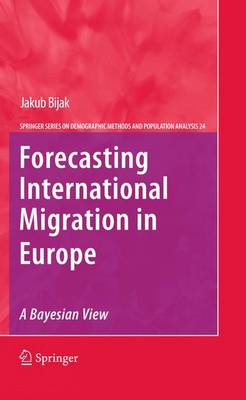
Forecasting International Migration in Europe: A Bayesian View - The Springer Series on Demographic Methods and Population Analysis
hardback
Published:
31 October, 2010

Popular Books by Jakub Bijak
View All Books by Jakub Bijak

Description
More Details
| Type | Book |
|---|---|
| ISBN13 | 9789048188963 |
| ISBN10 | 9048188962 |
| Number Of Pages | 316 |
| Item Weight | 1000 g |
| Publisher / Reseller | Springer |
| Format | hardback |
| Edition | 2011 ed. |
Media Reviews
From the reviews:
“Forecasters know (or at least should know) that their forecasts never come true and that the magnitude of error increases with the forecast's horizon. Jakub Bijak proposes an elegant solution to this problem, namely an application of Bayesian statistics to migration forecasting. Methodology he proposes allows for quantification of forecast uncertainty, giving the forecast's user an idea of how accurate the forecast is. As in the past a transition form single-regional to multi-regional forecasts constituted a milestone in demographic forecasting, the methodology proposed by Bijak and advocated earlier by other demographers will constitute a similar milestone in the future.” Dr Marek Kupiszewski, Director of the Central European Forum for Migration and Population Research in Warsaw
“The book is structured in five parts comprising twelve chapters. … The book is well-addressed to both policy- and theory-oriented readers, demographers and in particular statistical demographers, as well as to postgraduate students of demography and migration.” (Christina Diakaki, Zentralblatt MATH, Vol. 1209, 2011)