Argumentation in Multi-Agent Systems :6th International Workshop, ArgMAS 2009, Budapest, Hungary, May 12, 2009. Revised Selected and Invited Papers - Lecture Notes in Computer Science
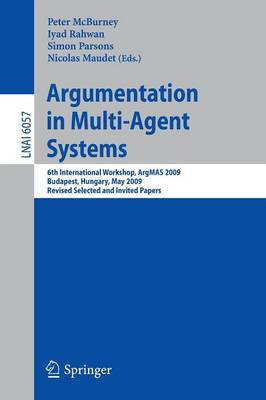
Argumentation in Multi-Agent Systems :6th International Workshop, ArgMAS 2009, Budapest, Hungary, May 12, 2009. Revised Selected and Invited Papers - Lecture Notes in Computer Science
paperback
Published:
10 May, 2010
paperback
Published:
10 May, 2010

Standard worldwide delivery by
Tue, July 21 - Fri, July 24
Order within
0
Description
This volume contains revised versions of the papers presented at the sixth e- tion of the International Workshop on Argumentation in Multi-Agent Systems, (ArgMAS2009),heldinBudapest,Hungary,inassociationwiththe8thInter- tional Conference on Autonomous Agents and Multi-Agent Systems (AAMAS 2009) in May 2009. Previous ArgMAS workshops have been held in New York City, USA (2004),Utrecht, The Netherlands (2005),Hakodate, Japan (2006), Honolulu, USA (2007) and Estoril, Portugal (2008). The event has now clearlyestablisheditselfonthe internationalcalendaramongresearchersinc- putational argument and dialectics. A brief word to explain these topics is in order. Di?erent agents within a multi-agent system (MAS) potentially have di?erential access to information and di?erent capabilities, di?erent beliefs, di?erent preferences and desires, and di?erent goals. A key aspect of the scienti?c and engineering study of mul- agentsystemsthereforehasbeenthedevelopmentofmethodsandproceduresfor identifying, assessing, reconciling, arbitrating between, managing, and mitig- ing suchdi?erences. Marketmechanismsandvotingproceduresaretwo methods fordealing with thesedi?erences. Argumentationisanother. Argumentationcan be understood as the formal interaction of di?erent arguments for and against some conclusion (e. g. , a proposition, an action intention, a preference, etc. ). An agent may use argumentation techniques to perform individual reasoning for itself alone, in order to resolve con?icting evidence or to decide between c- ?icting goals it may have. Two or more agents may also jointly use dialectical argumentationto identify, express,andreconciledi?erencesbetweenthemselves, by means of interactions such as negotiation, persuasion, inquiry, and joint - liberation.
More Details
| Type | Book |
|---|---|
| ISBN13 | 9783642128042 |
| ISBN10 | 3642128041 |
| Number Of Pages | 321 |
| Item Weight | 1000 g |
| Publisher / Reseller | Springer-Verlag Berlin and Heidelberg GmbH & Co. KG |
| Format | paperback |
See More +