Kalman Filtering :with Real-Time Applications
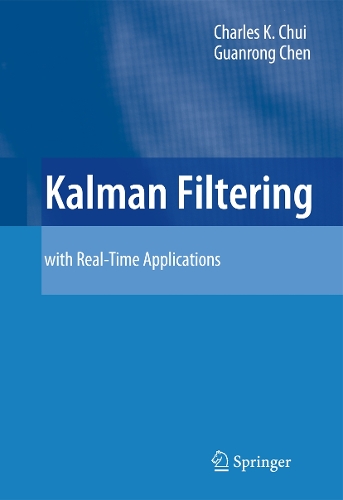
Kalman Filtering :with Real-Time Applications
paperback
Published:
19 October, 2010

Popular Books by Charles K. Chui
View All Books by Charles K. Chui


Description
More Details
| Type | Book |
|---|---|
| ISBN13 | 9783642099663 |
| ISBN10 | 3642099661 |
| Number Of Pages | 230 |
| Item Weight | 1000 g |
| Publisher / Reseller | Springer-Verlag Berlin and Heidelberg GmbH & Co. KG |
| Format | paperback |
| Edition | Fourth Edition 2009 |
Media Reviews
From the reviews:
“To summarize, the authors have succeeded in bringing together the mathematical theory and the needs of practitioners. The newly added chapters, in particular the one on wavelets, give the book a proper finish. For a book of this size, it leaves little to be desired. It presents a wealth of details while at the same time avoiding unnecessary abstraction.” (Andreas Ruppin, Berlin, Germany (SSN Stat. Software News, 2000, 34,3-4)
"A rigorous and concise introduction to Kalman filtering is presented in this well-written book. It is suitable for graduate studies, as well as refresher courses and self-study. … One of the strong features of the book is that Kalman filtering is presented from a few different viewpoints. … The many end-of-chapters exercises--and the section at the end of the book with solutions and hints to several of them--are another strong feature of the book." (Vladimir Botchev, ACM Computing Reviews, July, 2009)
From the reviews of the third edition:
“The proofs and derivations in the third edition of Kalman Filtering with Real-Time Applications lead to a deep understanding of the linear Kalman filter algorithm as an optimal estimator for the state sequence in a system with stochastic dynamics and measurements. It is a good book for researchers with a strong mathematical background who will be building Kalman filters and smoothers. It is also a good text for teaching a course on linear Kalman filtering and some of its extensions.” (Bradley M. Bell, SIAM Review, Vol. 52 (2), 2010)
From the reviews of the fourth edition:
“It is written not only for self-study but also for use in a one-quarter or one-semester introductory course on Kalman filtering theory for upper-division undergraduate or first-year graduate to applied mathematics or engineering students. In addition, it is hoped that it will become a valuable reference to any industrial or government engineer.” (George S. Stavrakakis, Zentralblatt MATH, Vol. 1206, 2011)