Reverse Logistics :Quantitative Models for Closed-Loop Supply Chains
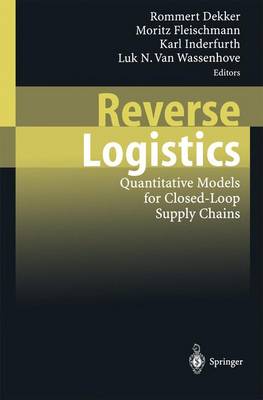
Reverse Logistics :Quantitative Models for Closed-Loop Supply Chains
paperback
Published:
5 December, 2010

Popular Books by Moritz Fleischmann
View All Books by Moritz Fleischmann
Description
Reverse logistics concerns the integration of used and obsolete products back into the supply chain as valuable resources. Economic, marketing, and legislative drivers increasingly are leading companies to take back and recover their products after use. The arising product flows pose novel challenges for supply chain management.
This book addresses decision making in reverse logistics. It covers a wide range of aspects, related to distribution, production and inventory management, and supply chain management. For each topic, it highlights key managerial issues in real-life examples and explains which quantitative models are available for addressing them. By treating a broad range of issues in a unified way, the book offers the reader a comprehensive view on the field of reverse logistics.
More Details
| Type | Book |
|---|---|
| ISBN13 | 9783642073809 |
| ISBN10 | 3642073808 |
| Number Of Pages | 436 |
| Item Weight | 1000 g |
| Publisher / Reseller | Springer-Verlag Berlin and Heidelberg GmbH & Co. KG |
| Format | paperback |
| Edition | Softcover reprint of hardcover 1st ed. 2004 |
Media Reviews
From the reviews:
"The editors have aimed this book at academics and students in the field of supply chain management. … the book should also be useful to practitioners in the field of supply chain management, especially those with a specific responsibility in product recovery. The many models presented in the book will provide them with a useful resource." (G. Rand, Journal of the Operational Research Society, Vol. 56, 2005)
"The book reveals a comprehensive insight into the main decision problems of Reverse Logistics. … The well-structured introduction, the broad reference section (more than 500 citations) and the attempt to enhance the theoretical analysis with plenty of informative case studies all help to increase the book’s value. Due to its numerous advantages I can recommend the book without any reservations whatsoever. Primarily, it might be helpful for scientists and students … . Formally educated practitioners will benefit from the book, too … ." (Rainer Souren, OR-Spectrum, Issue 21, 2004)