Agent-Oriented Information Systems II :6th International Bi-Conference Workshop, AOIS 2004, Riga, Latvia, June 8, 2004 and New York, NY, USA, July 20, 2004, Revised Selected Papers - Lecture Notes in Computer Science
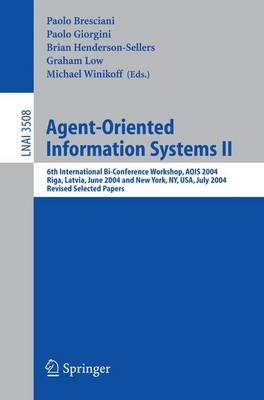
Agent-Oriented Information Systems II :6th International Bi-Conference Workshop, AOIS 2004, Riga, Latvia, June 8, 2004 and New York, NY, USA, July 20, 2004, Revised Selected Papers - Lecture Notes in Computer Science
paperback
Published:
12 May, 2005
paperback
Published:
12 May, 2005

Standard worldwide delivery by
Tue, June 30 - Thu, July 9
Order within
0
Description
Information systems have become the backbone of all kinds of organizations - day. In almost every sector – manufacturing, education, health care, government and businesses large and small – information systems are relied upon for - eryday work, communication, information gathering and decision-making. Yet, the in?exibilities in current technologies and methods have also resulted in poor performance, incompatibilities and obstacles to change. As many organizations are reinventing themselves to meet the challenges of global competition and e-commerce, there is increasing pressure to develop and deploy new technologies that are ?exible, robust and responsive to rapid and unexpected change. Agent concepts hold great promise for responding to the new realities of - formation systems. They o?er higher-level abstractions and mechanisms which address issues such as knowledge representation and reasoning, communication, coordination, cooperation among heterogeneous and autonomous parties, p- ception, commitments, goals, beliefs, intentions, etc., all of which need conc- tual modelling. On the one hand, the concrete implementation of these concepts can lead to advanced functionalities, e.g., in inference-based query answering, transaction control, adaptive work ?ows, brokering and integration of disparate information sources, and automated communication processes. On the other hand, their rich representational capabilities allow for more faithful and ?- ible treatments of complex organizational processes, leading to more e?ective requirements analysis and architectural/detailed design.
More Details
| Type | Book |
|---|---|
| ISBN13 | 9783540259114 |
| ISBN10 | 3540259112 |
| Number Of Pages | 230 |
| Item Weight | 1000 g |
| Publisher / Reseller | Springer-Verlag Berlin and Heidelberg GmbH & Co. KG |
| Format | paperback |
| Edition | 2005 ed. |
See More +