Principles and Practice of Semantic Web Reasoning :International Workshop, PPSWR 2003, Mumbai, India, December 8, 2003, Proceedings - Lecture Notes in Computer Science
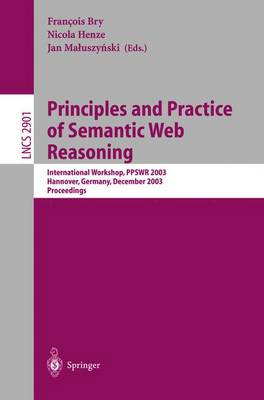
Principles and Practice of Semantic Web Reasoning :International Workshop, PPSWR 2003, Mumbai, India, December 8, 2003, Proceedings - Lecture Notes in Computer Science
paperback
Published:
25 November, 2003
paperback
Published:
25 November, 2003

Standard worldwide delivery by
Fri, July 31 - Wed, August 5
Order within
0
Popular Books by Jan Maluszynski
View All Books by Jan Maluszynski
Description
The Semantic Web is a major endeavor aimed at enriching the existing Web withmetadataandprocessingmethodssoastoprovideWeb-basedsystemswith advanced(so-calledintelligent)capabilities,inparticularwithcontext-awareness and decision support. The advanced capabilities striven for in most Semantic Web application s- narios primarily call for reasoning. Reasoning capabilities are o?ered by exi- ing Semantic Web languages, such as BPEL4WS, BPML, ConsVISor, DAML-S, JTP, TRIPLE, and others. These languages, however, were developed mostly from functionality-centered (e.g., ontology reasoning or access validation) or application-centered (e.g., Web service retrieval and composition) perspectives. A perspective centered on the reasoning techniques (e.g., forward or backward chaining, tableau-like methods, constraint reasoning, etc.) complementing the above-mentioned activities appears desirable for Semantic Web systems and - plications. The workshop on "Principles and Practice of Semantic Web Reas- ing," which took place on December 8, 2003, in Mumbai, India, was the ?rst of a series of scienti?c meetings devoted to such a perspective. JustasthecurrentWebisinherentlyheterogeneousindataformatsanddata semantics, the Semantic Web will be inherently heterogeneous in its reasoning forms.Indeed,anysingleformof reasoningturnsouttobeirrealin theSemantic Web. For example, ontology reasoning in general relies on monotonic negation (for the metadata often can be fully speci?ed), while databases, Web databases, and Web-based information systems call for non-monotonic reasoning (for one would not specify non-existing trains in a railway timetable); constraint reas- ing is needed when dealing with time (for time intervals have to be dealt with), while(forwardand/orbackward)chainingisthereasoningofchoicewhencoping with database-like views (for views, i.e., virtual data, can be derived from actual data using operations such as join and projections).
More Details
| Type | Book |
|---|---|
| ISBN13 | 9783540205821 |
| ISBN10 | 3540205829 |
| Number Of Pages | 214 |
| Item Weight | 1000 g |
| Publisher / Reseller | Springer-Verlag Berlin and Heidelberg GmbH & Co. KG |
| Format | paperback |
| Edition | 2003 ed. |
See More +