Adaptive Finite Elements in Linear and Nonlinear Solid and Structural Mechanics - CISM International Centre for Mechanical Sciences
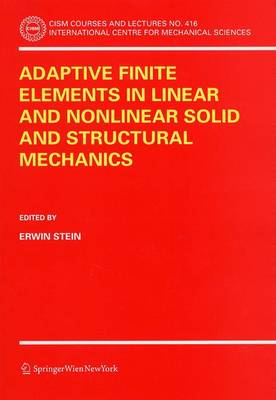
Adaptive Finite Elements in Linear and Nonlinear Solid and Structural Mechanics - CISM International Centre for Mechanical Sciences
paperback
Published:
3 August, 2005
paperback
Published:
3 August, 2005

Standard worldwide delivery by
Wed, September 2 - Mon, September 7
Order within
0
Popular Books by Erwin Stein
View All Books by Erwin Stein
Description
This course with 6 lecturers intends to present a systematic survey of recent re search results of well-known scientists on error-controlled adaptive finite element methods in solid and structural mechanics with emphasis to problem-dependent concepts for adaptivity, error analysis as well as h- and p-adaptive refinement techniques including meshing and remeshing. Challenging applications are of equal importance, including elastic and elastoplastic deformations of solids, con tact problems and thin-walled structures. Some major topics should be pointed out, namely: (i) The growing importance of goal-oriented and local error estimates for quan tities of interest—in comparison with global error estimates—based on dual finite element solutions; (a) The importance of the p-version of the finite element method in conjunction with parameter-dependent hierarchical approximations of the mathematical model, for example in boundary layers of elastic plates; (Hi) The choice of problem-oriented error measures in suitable norms, consider ing residual, averaging and hierarchical error estimates in conjunction with the efficiency of the associated adaptive computations; (iv) The importance of implicit local postprocessing with enhanced test spaces in order to get constant-free, i. e. absolute-not only relative-discretizati- error estimates; (v) The coupling of error-controlled adaptive discretizations and the mathemat ical modeling in related subdomains, such as boundary layers. The main goals of adaptivity are reliability and efficiency, combined with in sight and access to controls which are independent of the applied discretization methods. By these efforts, new paradigms in Computational Mechanics should be realized, namely verifications and even validations ofengineering models.
More Details
| Type | Book |
|---|---|
| ISBN13 | 9783211269756 |
| ISBN10 | 3211269754 |
| Number Of Pages | 363 |
| Item Weight | 1000 g |
| Publisher / Reseller | Springer Verlag GmbH |
| Format | paperback |
| Edition | 2005 ed. |
See More +