Indigenous Geographies in the Yucatan :Learning From the Responsibility-Based Maya Environmental Ethos - SpringerBriefs in Geography
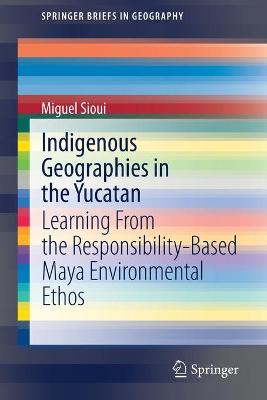
Indigenous Geographies in the Yucatan :Learning From the Responsibility-Based Maya Environmental Ethos - SpringerBriefs in Geography
paperback
Published:
26 January, 2021
paperback
Published:
26 January, 2021

Standard worldwide delivery by
Wed, June 24 - Fri, July 3
Order within
0
Condition:
NEW
$72.94
RRP
$73.36
You save $0.41 (1%)
Available
20+
in stock
FREE Returns within 30 days
Popular Books by Miguel Sioui
View All Books by Miguel Sioui
Description
This book is part of a broader attempt to decolonize colonial histories and understandings about Indigenous peoples and their relationships with their territories, and argues that the land ethos of "being part of the land," specifically among the Mayan community of Xuilub (Yucatan), Mexico, is guided by the cultural precept of 'responsibility-based' thinking. The work uniquely adds much needed insights into 'responsibility-based' thinking for land-use practices, and develops a theoretical framework for assessing historical impacts on Indigenous cultures and livelihoods. In six chapters, the text bridges Western and Indigenous Knowledge (IK) approaches to achieve deeper understanding of IKs, focusing on more Indigenous-centered methods, with the goal of expanding the disciplinary perspectives of postcolonial scholarship and Indigenous geographies. The book contains useful information for environmental planning/management scholars and geographers who may not be familiar with Indigenous approaches to land-use, and to Indigenous geographers working to bridge Western and Indigenous methodologies.
More Details
| Type | Book |
|---|---|
| ISBN13 | 9783030603984 |
| ISBN10 | 3030603989 |
| Number Of Pages | 128 |
| Item Weight | 1000 g |
| Publisher / Reseller | Springer Nature Switzerland AG |
| Format | paperback |
| Edition | 1st ed. 2020 |
See More +
Author's Bio
Miguel Sioui is an Assistant Professor in the Department of Geography and Environmental Studies at Wilfrid Laurier University. His current research aims to bridge Indigenous and Western academic epistemologies to foster the development of environmental strategies that are more likely to promote responsible and respectful relationships with the environment over the long term. It is his hope that this effort will help Canadian and global societies to deal more effectively with increasingly complex local, regional, and global environmental management challenges.