Spectroscopic Methods in Organic Chemistry
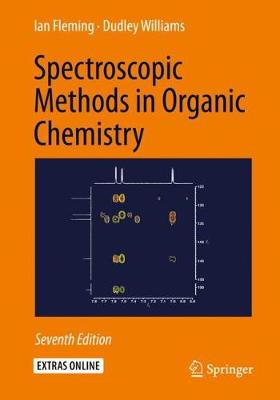
Spectroscopic Methods in Organic Chemistry
paperback
Published:
18 January, 2020

Popular Books by Ian Fleming
View All Books by Ian Fleming
Description
This book is a well-established guide to the interpretation of the mass, ultraviolet, infrared and nuclear magnetic resonance spectra of organic compounds. It is designed for students of organic chemistry taking a course in the application of these techniques to structure determination. The text also remains useful as a source of data for organic chemists to keep on their desks throughout their career.
In the seventh edition, substantial portions of the text have been revised reflecting knowledge gained during the author's teaching experience over the last seven years. The chapter on NMR has been divided into two separate chapters covering the 1D and 2D experiments. The discussion is also expanded to include accounts of the physics at a relatively simple level, following the development of the magnetization vectors as each pulse sequence is introduced. The emphasis on the uses of NMR spectroscopy in structure determination is retained. Worked examples and problem setsare included on a chapter level to allow students to practise their skills by determining the chemical structures of unknown compounds.
More Details
| Type | Book |
|---|---|
| ISBN13 | 9783030182519 |
| ISBN10 | 3030182517 |
| Number Of Pages | 432 |
| Item Weight | 1000 g |
| Publisher / Reseller | Springer Nature Switzerland AG |
| Format | paperback |
| Edition | 7th ed. 2019 |
GoodReads Reviews
Author's Bio
Professor Ian Fleming graduated from the University of Cambridge in 1959, obtained his PhD in 1962, and a Research Fellowship from 1962-64. He spent a post-doctoral year with R. B. Woodward at Harvard (1963-64), and then spent the rest of his career in the University of Cambridge, with sabbatical visits to teach at the University of Wisconsin, Madison (1980) and at Harvard (1990). He is well known in the organic chemistry world having been elected as a Fellow of the Royal Society in 1993 for his contributions to research in synthetic organic chemistry, with a special emphasis on the uses of organosilicon chemistry. After formal retirement from research in 2002, he has been writing, and continuing to carry out tutorial teaching in Pembroke College. From 2012 to 2018 he taught a one-semester course at the University of Illinois Urbana Champaign.