The Evidence of Things Not Seen :A Mountaineer's Tale
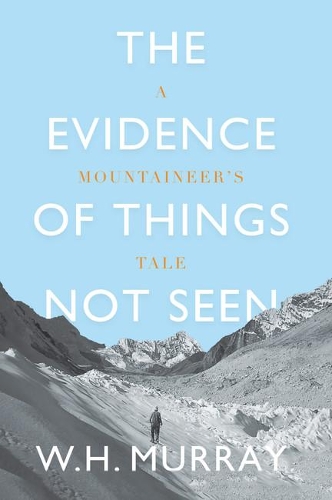
The Evidence of Things Not Seen :A Mountaineer's Tale
paperback
Published:
6 February, 2020

Popular Books by W. H. Murray
View All Books by W. H. Murray

Description
The Evidence of Things Not Seen is the autobiography of remarkable mountaineer, writer and environmentalist W.H. Murray. After being introduced to climbing in his early twenties, Murray’s relationship with the outdoors was shaped as much by his time on the mountains as away from them. His early Scottish climbs were brought to a halt by the Second World War, which saw him spend three years as a Nazi prisoner of war. These years were devoted to not only to philosophical study, but also to writing his classic Mountaineering in Scotland not once, but twice, on toilet paper.
The time to write about mountains only fuelled Murray’s enthusiasm to climb them. The regeneration in mountaineering that followed the war saw Murray complete three Himalayan expeditions, alongside other iconic figures such as Doug Scott, Tom MacKinnon and Tom Weir, and Eric Shipton. He not only explored Himalayan peaks never before attempted by westerners, but also established the crucial Khumbu Icefall route up Everest, which paved the way for the mountain’s first ascent in 1953.
Later life saw Murray return to Scotland and begin the fight to conserve the wild places that motivated him. From pioneering the John Muir Trust to fighting threats to forestry, Murray’s writing is laced with a philosophical edge and a contagious appreciation for Scotland’s wild places, capturing the essence of why Murray’s work has been inspiring readers for decades.
Written just before his death in 1996, and with a foreword by renowned Scottish mountaineer Hamish MacInnes, The Evidence of Things Not Seen is a must-read for anyone for which the mountains are still a source of wonder.
More Details
| Type | Book |
|---|---|
| ISBN13 | 9781912560820 |
| ISBN10 | 1912560828 |
| Number Of Pages | 346 |
| Item Weight | 500 g |
| Product Dimensions | 156 x 234 x 20 mm |
| Publisher / Reseller | Vertebrate Publishing Ltd |
| Format | paperback |
| Edition | New edition |
Media Reviews
A big, quiet book that resonated beyond the clamour of ego and conquest. – Dermot Somers, Judge, Banff Mountain Festival of Literature and Culture.
This autobiography captures the huge scope of Murray's extraordinary life - I'd wager that many climbers under thirty have read little of Murray, seeing him as a remote figure from the past. This book has changed all that and made him relevant and current. – Ed Douglas, Climber Magazine.
Would it live up to expectations? The answer is a resounding yes. Murray's words of optimism, insight and humility flow from each page, No inflated ego, no cynicism, no backbiting - and no false modesty either. – Jim Curran, High.
Through the concise and page-turning war days we learn that the author spent two years scribing Mountaineering in Scotland on toilet paper. The Gestapo found the then manuscript, interrogated Murray and then destroyed it, believing it was coded intelligence information. Over the next two years Murray describes how he forced himself to rewrite the book. – Jonathan Waterman, American Alpine Journal.
Bill Murray married a poet and the poetic sensibility which so often gives his work its depth is on display here. Its prose enhanced by pages of sumptuous photographs, valuable artefacts of climbing history in themselves, The Evidence of Things Not Seen is the memorial Murray deserves. Like a Highland sunset, his talent flared in glory one final time. – David Rose, The Guardian.
GoodReads Reviews
Author's Bio
W.H. Murray was born in Liverpool in 1913. Two years later his father was killed at Gallipoli, so his family moved back to Glasgow where Murray spent his childhood, school and college years before beginning a career in banking. He made his first climbs in 1934 and later joined a talented group of climbers in the Junior Mountaineering Club of Scotland. Murray describes how they strove to regain the dynamism of the early Scottish climbing that had been lost in the trauma of the Great War. After surviving long periods as a prisoner of war, attributed by some to his study of philosophy, Murray returned to mountaineering and later took part in key Himalayan expeditions of the 1950s. In 1951 Murray was on the critical reconnaissance that established a potential route up Everest via the Khumbu Icefall. Marrying happily, Murray built a career as a writer and conservationist, writing Highland Landscape, a counsel of protection, for the National Trust of Scotland. Murray died in 1996, and The Evidence of Things not Seen was published posthumously.