The Unknown Neruda
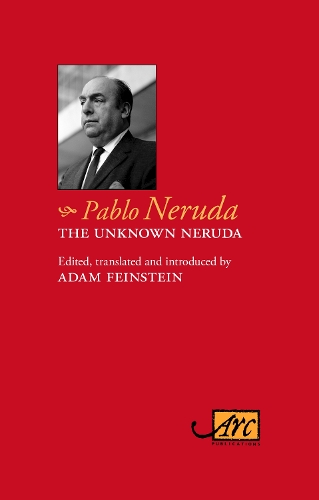
The Unknown Neruda
paperback
Published:
16 September, 2019

Popular Books by Pablo Neruda
View All Books by Pablo Neruda

Description
Referred to as ‘the greatest poet of the twentieth century in any language’, the Chilean poet Pablo Neruda has been published in the original Spanish and in translation throughout the world. So it is remarkable that some of this Nobel Prize-winner’s verse has never been published in English and this book goes a long way to filling this extraordinary gap. Edited and translated by Neruda’s acclaimed biographer, Adam Feinstein, these brand-new versions begin in 1919, when the fifteen-year-old boy, still called Neftalí Reyes, was feeling his literary way in Temuco, in southern Chile. The book follows him to the capital, Santiago, and to his first published collection, Crepusculario, in 1923, then on through many of his further collections up to his final works in the early 1970s. Neruda’s poetry is a fusion of beautiful love poetry and politically engaged verse, lyrical and apocalyptic by turns, and in few poets can life and work be so intimately interwoven: Adam Feinstein provides an illuminating introduction which puts these poems in the context of a man of memorable actions as well as words.
Prizes
Winner of Nobel Prize for Literature 1971
More Details
| Type | Book |
|---|---|
| ISBN13 | 9781911469131 |
| ISBN10 | 1911469134 |
| Number Of Pages | 144 |
| Item Weight | 235 g |
| Publisher / Reseller | Arc Publications |
| Format | paperback |
Author's Bio
Numerous critics have praised Neruda as the greatest poet writing in the Spanish language during his lifetime. Born Ricardo Eliezer Neftali Reyes y Basoalto, Neruda grew up in Temuco in the backwoods of southern Chile. Among his early teachers was the poet Gabriela Mistral, who would be a Nobel laureate years before Neruda. While in Santiago attending college, Neruda completed one of his most critically acclaimed and original works, ‘Twenty Love Poems and a Song of Despair’. Neruda’s professional career as Chilean consul, first in the Far East and then in Spain, involved him in the international republican and Communist movements, which led to a marked and enduring politicization of his poetics. After the election of the Socialist President of Chile, Salvador Allende, Neruda was dispatched as ambassador to France, and it was during this posting that he was awarded the Nobel Prize for literature. Adam Feinstein is an acclaimed author, translator, journalist and Hispanist. His biography Pablo Neruda: a passion for life was first published by Bloomsbury in 2004 and reissued in an updated edition in 2013 (Harold Pinter called it ‘a masterpiece’). Also in 2013, Feinstein launched Cantalao, a biannual magazine dedicated to Neruda’s life and work. Feinstein’s translations from Neruda, Lorca, Benedetti and others have appeared in many publications, including Modern Poetry in Translation and Agenda. His book of translations from Neruda’s Canto General, with colour illustrations by the Brazilian artist, Ana Maria Pacheco, was published by Pratt Contemporary in 2013. He also wrote the introduction to the Folio Edition of Jorge Luis Borges’ Labyrinths, which appeared in 2007. Feinstein’s other main field is autism. His book A History of Autism: conversations with the pioneers (Wiley-Blackwell, 2010) received widespread praise (Professor Simon Baron-Cohen said it was ‘a treasure trove … and a terrific book’). In 1998, Feinstein founded an international autism magazine, Looking Up. Based in London, he also runs monthly online autism conferences on the Awares conference site for Autism Cymru, as well as the annual online Awares conference, which has been called ‘the finest online event of its kind on the planet’. Feinstein has written for the Guardian, the TLS and the New Statesman and has broadcast for the BBC on Neruda and autism. He is currently writing a novel, as well as preparing a book on Cuban cultural policy since the Revolution.