HAIRAN :Poems of Hair and Freedom by Iranian Women in Times of Repression and Struggle
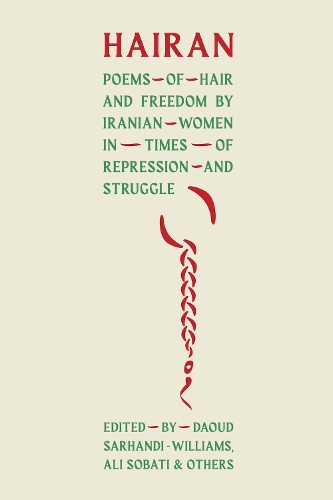
HAIRAN :Poems of Hair and Freedom by Iranian Women in Times of Repression and Struggle
paperback
Published:
15 October, 2024

Popular Books by Daoud Sarhandi-Williams
View All Books by Daoud Sarhandi-Williams
Description
And do not relinquish the search
For that limitless light
So that in the street, stars
Morph into comets
Extract from 'This Place (...)'
HAIRAN is a new anthology of poetry by Iranian women, compiled in the face of the violent attacks on life and liberty that began with the death of Mahsa Amini in Tehran in September 2022. Amini was arrested and killed in police custody for not covering enough of her hair in public.
Here are 76 poems from a diverse cross-section of contemporary Iranian voices, accompanied by ‘hair portraits’ taken by the poets.
Alongside Sobati and Sarhandi-Williams, HAIRAN was edited by Sepideh Jodeyri, Sepideh Kouti, Anna Krasnowolska, Anahita Rezaei, and Abbas Shokri.
More Details
| Type | Book |
|---|---|
| ISBN13 | 9781910895962 |
| ISBN10 | 1910895962 |
| Number Of Pages | 232 |
| Item Weight | 370 g |
| Publisher / Reseller | Scotland Street Press |
| Format | paperback |
Media Reviews
HERE’S the question: When
the majority of the
population of a country
are of a certain opinion,
and their preference forms the rule
of law, should you ever go against it?
And if it is not your own country,
what right do you have to offer an
opinion anyway?
Populism is its own reward: victory
comes with widespread ignorance
because democracy requires education.
Without sufficient education to
know what you’re choosing between,
you don’t really know what you’re
choosing at all. In effect, you have no
choice, just blind faith.
And that’s what increasingly rules
in the world: blind faith in a convicted
criminal, in a “Conservative” Party
whose mere existence endorses class
hierarchy, inherited wealth, a sense
of entitlement, racism, colonialism,
institutionalised theft; or blind faith
in a “Labour” Party whose practices
are not so far removed. Or in an SNP
leadership posing for selfies beside
representatives of English regions
and cities. Is such self-abasement
completely beyond recall?
But there is a deeper question.
Supposing for a moment there are
a few independent minds at work
who see such things happening and
maybe have a chance to point out the
hypocrisies and duplicities, the lying.
Is it arrogance to try to be reasonable
in the face of genocide? Can I present
a calm front while talking about
horrifying violence and the targeted
destruction of non-combatants, men,
women, children, old folk, babies?
Supposing I believe in certain
universal principles. To quote
the Palestinian literary critic and
historian Edward Said, supposing
I believe that “all human beings are
entitled to expect decent standards
of behaviour concerning freedom
and justice from worldly powers
or nations, and that deliberate or
inadvertent violations of these
standards needs to be testified and
fought against courageously”.
To however modest an extent, one is
Abbas Shokri, and how
then, after gathering more
than 200 pages of poems,
contact was made with
Ali Sobati, an Iranian
Farsi-English translator
and contemporary poetry
critic living in Canada, and
the book began to come
together.
The story of the
international editorial
team, comrades in
collaboration with different,
complementary specialisms,
and the beautiful product
itself, published by Scotland
Street Press, is one essential
context in which to read
the poems. See: www.
scotlandstreetpress.com/
product/hairan-poems-of-hair-andfreedom
THERE is a larger context.
More from the Preface: “As
this book goes to press, well
over 200 Iranian protesters
have died, thousands have been
arrested, and unknown numbers
have been tortured.
“Several male demonstrators
have been executed, often after
being convicted on trumped-up
charges under a catch-all crime that
translates into English as ‘corruption
on earth’. Furthermore, many
Iranians have been forced to flee
into exile, joining a diaspora that
now numbers between four and eight
million people.
“Despite ongoing protests,
however, the Iranian regime seems
to be doubling down on its efforts to
restrict women’s rights. Shops will
be penalised if they serve a woman
who enters their premises with her
head uncovered, smart cameras
that can spot women who aren’t
covering their hair ‘correctly’ are
being installed in urban spaces, and
the ‘crime’ of not wearing a hijab
outdoors is being considered for a
mandatory 10-year prison term – up
from a maximum of two months. In
hopefully committed to “advance the
cause of freedom and justice”.
As Said puts it, an intellectual
“is an individual endowed with a
faculty for representing, embodying,
articulating a message, a view, an
attitude, philosophy or opinion to, as
well as for, a public”.
Those statements come from Said’s
1993 Reith Lectures, Representations
of the Intellectual, but that last
description I think might apply
equally well to poets and artists of
all kinds, as well as professional
intellectuals employed in various
capacities, either working for or
publicly criticising corporate bodies,
governments, social states and
conditions. And the poets represented
in a new anthology I’ve just been
reading are all of this kind.
It is one of the most extraordinary
books I’ve seen in recent months.
This is from the Preface, by Daoud
Sarhandi-Williams, co-editor along
with Ali Sobati: “I was sitting at my
desk in September 2022 … when I
heard the shocking news about a
young Kurdish-Iranian woman called
Mahsa Amini. She had been arrested
in Tehran and killed in police custody
for not covering her hair in the
decreed way.
“Throughout Iran, women and girls
of all ages rose in fury against the
regime. The mandatory hijab head
covering, and hair itself, became a
powerful symbol in a struggle for
women’s liberation, personal freedom
and choice. In the autumn of 2022,
I didn’t know much about Iranian
poetry. However, I decided to find out
how contemporary female Iranian
poets were responding to their
oppression.”
The resulting book is both a
compendium of poems in protest
against the killing of Mahsa Amini,
to whom it is dedicated, and also an
introduction to Iranian poetry from
the perspective of writing by women.
The Preface describes how Daoud
contacted the Polish Iranologist Anna
Krasnowolska, who suggested getting
in touch with an Iranian publisher,
Some of the
13 anonymous
portraits
in Hairan
which were
commissioned
for the book.
All were
sent to the
editors in
low-resolution
by messenger
app and
acknowledgements
go to
the unknown
photographers
whose
portraits of
their friends,
family
members
or partners
appear there
The book’s
cover and
(main
picture)
Mahsa Amini,
to whom it is
dedicated
all these ways, public spaces that
are safe for dissenting women in
Iran are shrinking and becoming
more dangerous. The objectives
of this book are twofold: to
share with the general reader
an extraordinary collection of
contemporary Iranian women’s
poetry that has rarely, if ever,
been translated on this scale.
“The verse is passionate,
inspiring, and hallucinatory
in its mix of beauty and horror,
courage and fear, despair and hope.
Collectively, it powerfully expresses
the sentiment words – and poetic
words – can still play a vital role in
bringing about social and political
change. It shows us poetry matters.
“The second objective … is to
promote women’s civil and human
rights in Iran, as well as in other
countries that adhere to similar
or even more extreme doctrines
regarding the role and place of
women and girls.
“As this book goes to press, a
resurgent Taliban in Afghanistan
… has not only banned secondary
and higher education for girls, but
is also bringing back the public
stoning of women judged ‘guilty’ of
some reported moral failing or petty
misconduct. Meanwhile, arresting
and then sexually abusing Afghan
women for ‘bad hijab’ is routine.”
Shouldn’t we in Scotland also be
hoping “that Muslim women will
have the freedom to cover or not
cover their hair, and that both choices
will be treated equally. And that
such basic liberties will extend to all
aspects of their lives”?
That’s the immediate context.
And it should take us back to
the first principles I began with,
Edward Said’s belief that “all human
beings are entitled to expect decent
standards of behaviour concerning
freedom and justice from worldly
powers or nations, and that deliberate
or inadvertent violations of these
standards needs to be testified and
fought against courageously.”
And that, in however modest a way,
and to whatever extent we can, we are
hopefully committed to “advance the
cause of freedom and justice”.
Let me add another voice from a
different continent, at a time when
it’s worth reminding ourselves of the
truly great values and aspirations
America has at times embodied, the
fiercest political poet of that country,
Edward Dorn. He puts it very simply:
“Either we define our allegiances to
certain honorific aspects of human
nature or we don’t.
“Most of us know all the time that
politics in poetry really amounts
to enunciation. Politics in politics
amounts to subterfuge, obscurantism
and hiding all you can.”
So there you are: “certain honorific
aspects” of being human. Nobody,
whatever their cultural history, should
stone women to death or kill them for
showing their hair. Nowhere on Earth
should these things be legitimate.
And that’s the clear enunciation of
every poem in this book, and another
reason why it’s such a remarkable
collection.
And there’s more. The Introduction,
by Ali Sobati with Anahita Rezaei,
Sepideh Jodeyri and Sepideh Kouti,
traces out the whole story of “the
silenced trajectory” in the story
of a feminine voice in “the extramillennial
past of Iranian poetry”.
In the 1990s, Reza Barahani
(1935-2022), a life-long radical (male)
literary critic and theorist, called for
an “alternative womanly narrative”
and suggested that the 1937 novel
The Blind Owl, by the (male)
writer Sadegh Hedayat (1903–51),
as a founding modernist work in
Farsi literature, has been “doubly
problematic” because “in this novel
female characters are denied the right
to bear a name or the right to name –
they are simply not allowed to speak
for themselves”.
The novel presents a surrealist/
expressionist account (drawing on
the early silent movies of Luis Buñuel
and FW Murnau) of characters
“decalcomaniacally copy and
pasted one into another.” But its
attractiveness as surrealist modernism
is undermined by its exclusive
patriarchal priorities. “This situation,
however, is by no means confined
to The Blind Owl … it is ascribable
to almost the entire Iranian literary
tradition and history.”
SO, here’s the drive: “Now it is
time for the woman to become
the narrator of her world and
to do the naming herself,”
wrote Barahani. “In literature, a
woman’s freedom means that she
can define both herself and her
surroundings.”
The Introduction builds from
there. This book comes as a work of
redress, and effectively of defiance,
and celebration. “Most of these poems
were composed (in Farsi) in response
to unique social and political events in
contemporary Iran: often, they are a
tacit or direct response to the Woman
Life Freedom (or WLF) movement,
which grew out of Mahsa Amini’s
death ...
“The poems either elegiacally
mourn Iran’s fallen heroes – lost
during an ultra-violent crackdown
by the regime – or they celebrate the
phenomenal bravery of women
and girls, as well as the courage
of many fearlessly supportive
men. And even if not
connected to WLF events,
the poems still speak
to other contemporary
sociopolitical events and
tragedies in Iran, and
almost always from a
feminist standpoint.”
The Introduction takes
us through three periods (the
classical, transitional, and
modern-contemporary), to give “an
overarching historical context for
the poems in the anthology”.
These three periods are
worth noting before I quote
a couple of the poems. To
begin with, there is –
THE AGE OF ORIGINS:
THE POST-ISLAMIC,
CLASSICAL PERIOD
“The originary points of
Iranian women’s poetry
are rather blurred. This is
due to the imposed ‘silenced
trajectory’, that leaves us with
little to no evidence and often with
centuries-long holes in what
evidence is available.”
Then follows THE
TRANSITIONAL
AGE: QAJAR AND
CONSTITUTIONAL
REVOLUTION but it’s
taken an awfully long
time before we begin to
get anywhere near those
“honorific aspects” of being
human that Ed Dorn speaks
of, or the principle that Edward
Said makes explicit, that “human
beings are entitled to expect decent
standards of behavior concerning
freedom and justice from
worldly powers or nations,
and that deliberate or
inadvertent violations of
these standards needs to be
testified and fought against
courageously.”
And yet, progress is
possible, change does
happen. We come to
THE AGE OF FEMINIST
WRITING: PRE- AND
POST-1979 REVOLUTION and
we’re informed: “It is not far-fetched
to consider this period to be that
in which the ‘silenced trajectory’ is
finally broken – giving way to the
birth of womanly poetry with an
inherent femininity.”
And this brings us to THE AGE
OF WOMAN LIFE FREEDOM:
THIS ANTHOLOGY’S
CONTEMPORARIES, and here,
we read: “The concrete plurality of
such distinguished literary voices
profoundly resonates with the
momentum of the Woman Life
Freedom feminist uprising – not only
in Iran but in the entire region. This
highly consequential, but largely
unanticipated, uprising occurred
most forcefully between 2022-23.
“The crackdown against it, even by
the standards of the brutal theocratic
regime that rules Iran, has been
extreme: more than 22,000 arrested;
more than 500 reported deaths,
including of 71 children; various
types of child abuse – with all this
accompanied by a glut of torture,
execution and injury.”
And yet, to come to the poems
themselves, we should understand
as a governing principle for
the whole anthology the fact
that “Woman Life Freedom’s
ability to surpass all national
boundaries lies in its high
degree of translatability into
a basic condition of
de-subjugation.”
Translation has a universal
application, here in Scotland as
much as anywhere in the world.
Consider that as you let the poems
sink in. No more commentary now,
just two poems to sample. First,
“YOU’D SAID …” by Fanuous
Bahadorvand:
You’d said
Don’t write poems
Be a woman
Then life itself becomes
poetic
Becomes spring
Becomes plain yet vivid
On the flow of wine in
Mahsa’s hair
Or the nightly hair of Leily
Free of whatever metaphor
Yet, I was the last resort
To words in ashes
In the hearty texts in flames
Or marble dead souls
Growing ever colder
Ice-ageing the world
And the landscape of my
imagination
As if a gloomy sunset,
Expired on seven
In the morgues of paradise
The words in ashes
Were about to show
Death for life
And life for a persistent conspiracy
With ups and downs in a foe’s
synecdoche
Or certain self-decided deaths
But I was forced
To become a choice
For the heart
Poetry
“Woman
Life
Freedom…”
The references there are
worth noting: “Mahsa Amini,
the young woman whose death
inspired the Woman Life Freedom
movement. She was killed in Tehran
by the so-called morality police, on
September 16, 2022, for showing too
much hair.”
And Leily, we’re told, is “A
common female name in Iran, but
also a possible allusion to Leili in
Nezami Ganjavi’s epic romance, Leili
and Majnoon (Leyla and Majnun in
English). This book is often referred
to as the Middle Eastern Romeo and
Juliet, but Nezami’s masterpiece was
written in 1192, around 400 years
before Shakespeare wrote his play
with a similar plot.”
And here’s “TO LEARN” by
Rouhangiz Karachi (Composed in
Tehran in 2021):
I have learned
To cry my dreams, slowly
And imprison love
In the white of papers
As stormy gusts advance
And be a woman
In a room with no window
Other than imagination.
-- Alan Riach * Uncovering Women's Fight Against Tyranny *"It is one of the most extraordinary books I've seen in recent months...This book comes as a work of redress, and effectively of defiance, and celebration."
-- Alan Riach * Uncovering women's fight against tyranny *Author's Bio
Sepideh Jodeyri is an award-winning Iranian poet and translator living in Washington DC, USA. She is the author of 11 books.
Sepideh Kouti is an Iranian poet, author, translator, and editor. She began her literary career in 2000, authoring entries for the Encyclopedia of Persian Literature. Previous works include On the Heights of Despair (translation) and The Creeping Shadow of Objects.
Anna Krasnowolska is a Professor and esteemed specialist in Persian literature and Iranian culture. She was Director of the Institute of Oriental Studies (1999-2002), and Head of the Department of Iranian Studies (2000-17) at Jagiellonian University.
Anahita Rezaei is an award-winning Iranian writer and literary critic living in Tehran, Iran. Previous works include Silent and Quiet of Being–Not Being Days and The Shooting Right to Domestic Dogs.
Daoud Sarhandi-Williams is an award-winning, multidisciplinary filmmaker and writer of Anglo-Indian and Pakistani heritage. Previous titles include Bosnian War Posters and Ukraine at War: Street Art, Posters + Poetry.
Abbas Shokri fled Iran in 1989 to save his life, and finally settled in Norway. He retrained as a journalist in 1995 and founded Aftab, a Persian language press which publishes censored Iranian authors. He is the author of 14 books.
Ali Sobati is an Iranian poet, critic, essayist, journalist, and translator. For over two decades he has been one of the leading academic literary voices of his generation. Ali is currently based outside Iran.