The Political Ecology of the Metropolis :Metropolitan Sources of Electoral Behaviour in Eleven Countries
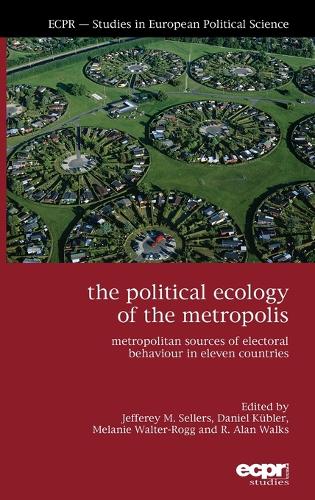
The Political Ecology of the Metropolis :Metropolitan Sources of Electoral Behaviour in Eleven Countries
hardback
Published:
1 June, 2013

Popular Books by Daniel Kübler
View All Books by Daniel Kübler

Description
More Details
| Type | Book |
|---|---|
| ISBN13 | 9781907301377 |
| ISBN10 | 1907301372 |
| Number Of Pages | 534 |
| Item Weight | 413 g |
| Publisher / Reseller | ECPR Press |
| Format | hardback |
Media Reviews
'Based on a painstaking empirical analysis of eleven country cases, this study documents the pervasiveness and importance of the re-territorialisation of politics in a globalised world. This return of territory is not patterned along cleavages as we know them, but based on new territorialised contrasts within and between metropolitan areas. The thought-provoking study draws our attention to the challenge the metropolitanisation of politics poses to national parties and democratic traditions.' Hanspeter Kriesi, Stein Rokkan Chair for Comparative Politics, European University Institute 'A virtuoso work of comparative politics filled with insights about how places condition politics. This magisterial achievement gathers uniform electoral data from different parts of the main metropolitan areas of the US, Canada, Western and Eastern Europe and Israel, analyses them using the same methods, including multi-level analysis, and paints a definitive portrait of the changing metropolitan political terrains and their implications for national politics. A must-read for all those interested in the geography of politics.' Professor John Mollenkopf, Distinguished Professor of Political Science and Sociology, The Graduate Center, City University of New York 'This book starts from the observation that in recent years urbanised centres have emerged all over the world, influencing their surrounding areas. Against the background of this metropolitanisation of contemporary societies, the authors reflect critically on the widespread assumption that national institutions and national political cleavages determine political conflicts, party structures and voting behaviour, not only at national but also at regional and local level. Has the emergence of metropolitan regions changed the conditions on which this assumption has been based? And in which way do the new metropolitanised spatial structures impact on political behaviour in metropolitan regions? These are the questions tackled by an international research team over the last ten years. The results published in this book are thought-provoking because they show clearly that to understand political processes in contemporary societies we have to take what the authors call the newly evolved metropolitan political ecology seriously.' Hubert Heinelt, Professor for Public Administration, Institute of Political Science, Technische Universitat Darmstadt 'This sophisticated and detailed empirical analysis of political participation and partisanship in a range of countries successfully challenges the dominant nationalisation thesis that where you live increasingly does not matter to your political outlook and behaviour. In a world that is increasingly organised socio-spatially in terms of metropolitan regions, the social settings provided by metropolitan places now crucially shape the contours of mass politics. Studies can no longer ignore the critical place contexts identified so clearly in this path-breaking volume.' John Agnew, Distinguished Professor of Geography, University of California 'Metropolitan space matters, whether for electoral turnout or the alignment of political parties in post-industrial democracies. And the effect of space is not simply that of compositional processes aggregating citizens of particular types and convictions in the same places. There is a political effect sui generis following from people converging in dense metropolitan areas or living in dispersed open spaces. This book constitutes an ambitious and comprehensive undertaking to drive this point home, convincing in its empirical scope, depth and rigour. It also poses new puzzles: What exactly is the experience of social space that makes people update their political dispositions? And dynamically, are people drawn to spaces that exercise such effects?' Herbert Kitschelt, George V Allen Professor of International Relations, Duke University