Coercing, Constraining and Signalling :Explaining UN and EU Sanctions After the Cold War
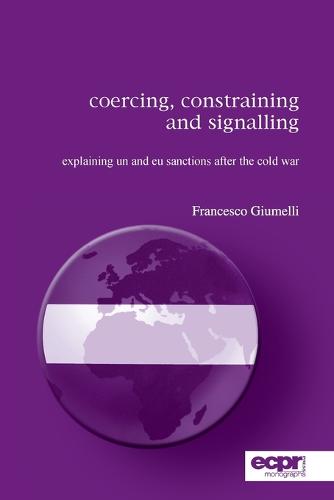
Coercing, Constraining and Signalling :Explaining UN and EU Sanctions After the Cold War
paperback
Published:
1 September, 2011

Popular Books by Francesco Giumelli
View All Books by Francesco Giumelli
Description
More Details
| Type | Book |
|---|---|
| ISBN13 | 9781907301209 |
| ISBN10 | 1907301208 |
| Number Of Pages | 226 |
| Item Weight | 395 g |
| Product Dimensions | 156 x 234 x 14 mm |
| Publisher / Reseller | ECPR Press |
| Format | paperback |
Media Reviews
This is a thoughtful study of economic sanctions as instruments of statecraft together with other forms of statecraft in pursuit of a variety of foreign policy goals. To his credit, the author neither dismisses nor ignores signaling as a foreign policy device. -- David A. Baldwin, Princeton University
In his important contribution to the field of UN and EU targeted sanctions, Francesco Giumelli provides an excellent conceptual account of the challenges this strategic tool confronts in today's world. He does so by providing both an excellent theoretical as well as methodological analysis, especially with regard to strategies of coercing, constraining and signalling. What more is that Dr. Giumelli also provides scientific recommendations for how to move the field forward. In short then, this book should be a required reading for anyone interested in the state of the art of sanctions. -- Mikael Eriksson, Researcher, Swedish Defence Research Agency
Francesco Giumelli's analytical distinction between the different purposes of sanctions - to coerce, to constrain, to signal - introduces an innovative way to think about and to evaluate the effectiveness of sanctions. -- Thomas J. Biersteker, Curt Gasteyger Chair in International Security and Conflict Studies, The Graduate Institute of International and Development Studies