Our Posthuman Future :Consequences of the Biotechnology Revolution
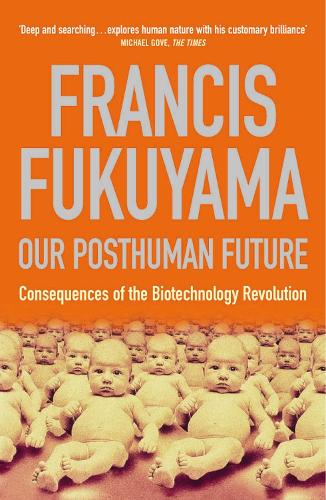
Our Posthuman Future :Consequences of the Biotechnology Revolution
Paperback
Published:
3 April, 2003
Paperback
Published:
3 April, 2003

Standard worldwide delivery by
Tue, June 23 - Fri, June 26
Order within
0
Condition:
NEW
$15.28
RRP
$17.39
You save $2.12 (12%)
Available
10
in stock
FREE Returns within 30 days
Popular Books by Francis Fukuyama
View All Books by Francis Fukuyama

Description
Is a baby whose personality has been chosen from a gene supermarket still a human? If we choose what we create what happens to morality? Is this the end of human nature? The dramatic advances in DNA technology over the last few years are the stuff of science fiction. It is now not only possible to clone human beings it is happening. For the first time since the creation of the earth four billion years ago, or the emergence of mankind 10 million years ago, people will be able to choose their children's' sex, height, colour, personality traits and intelligence. It will even be possible to create 'superhumans' by mixing human genes with those of other animals for extra strength or longevity. But is this desirable? What are the moral and political consequences? Will it mean anything to talk about 'human nature' any more? Is this the end of human beings? Our Posthuman Future is a passionate analysis of the greatest political and moral problem ever to face the human race.
More Details
| Type | Book |
|---|---|
| ISBN13 | 9781861974952 |
| ISBN10 | 1861974957 |
| Number Of Pages | 272 |
| Item Weight | 200 g |
| Product Dimensions | 128 x 196 x 24 mm |
| Publisher / Reseller | Profile Books Ltd |
| Format | Paperback |
| Edition | Main |
See More +
Media Reviews
'Deep and searching...explores human nature with his customary brilliance' Michael Gove, the Times
Author's Bio
Francis Fukuyama is the author of The End of History, Trust, The Great Disruption, Our Posthuman Future and State Building. All have been international bestsellers, translated and published in many languages. They have also been hugely influential. Fukuyama is in constant demand around the world in the media and as a speaker. He is Professor of International Political Economy at John Hopkins University.