Modern Epic :The World System from Goethe to García Márquez
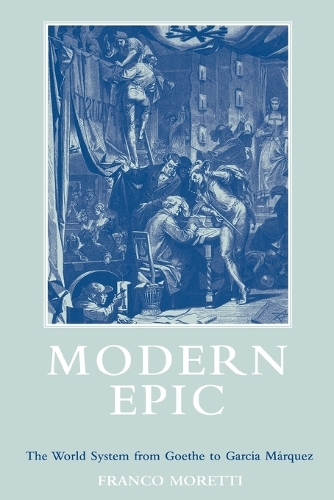
Modern Epic :The World System from Goethe to García Márquez
paperback
Published:
17 April, 1996
paperback
Published:
17 April, 1996

Standard worldwide delivery by
Fri, July 17 - Wed, July 22
Order within
0
Popular Books by Franco Moretti
View All Books by Franco Moretti
Description
"Take Faust, what is it? A 'tragedy', as its author states? A great philosophical tale? A collection of lyrical insights? Who can say. How about Moby-Dick? Encyclopedia, novel or romance? Or even a 'singular medley,' as one anonymous 1851 review put it? ... 'It is no longer a novel,' T.S. Eliot said of Ulysses. But if not novels, then what are they?"
Literary history has long been puzzled by how to classify and treat these aesthetic monuments. In this highly original and interdisciplinary work, Franco Moretti builds a theory of the modern epic: a sort of super-genre that has provided many of the "sacred texts" of Western literary culture. He provides a taxonomy capable of accommodating Faust, Moby-Dick, The Nibelung's Ring, Ulysses, The Cantos, The Waste Land, The Man Without Qualities and One Hundred Years of Solitude.
For Moretti the significance of the modern epic reaches well beyond the aesthetic sphere: it is the form that represents the European domination of the planet, and establishes a solid consent around it. Political ambition and formal inventiveness are here continuously entwined, as the representation of the world system stimulates the technical breakthroughs of polyphony, reverie and leitmotif; of the stream of consciousness, collage and complexity.
Opening with an analysis of Goethe's Faust and the different historical roles of epic and the novel, Moretti moves through a discussion of Wagner's Ring and on to a sociology of modernist technique. He ends with a fascinating interpretation of "magic realism" as a compromise formation between a number of modernist devices and the return of narrative interest, and suggests that the west's enthusiastic reception of these texts (and One Hundred Years of Solitude in particular) constitutes a ritual self-absolution for centuries of colonialism.
Literary history has long been puzzled by how to classify and treat these aesthetic monuments. In this highly original and interdisciplinary work, Franco Moretti builds a theory of the modern epic: a sort of super-genre that has provided many of the "sacred texts" of Western literary culture. He provides a taxonomy capable of accommodating Faust, Moby-Dick, The Nibelung's Ring, Ulysses, The Cantos, The Waste Land, The Man Without Qualities and One Hundred Years of Solitude.
For Moretti the significance of the modern epic reaches well beyond the aesthetic sphere: it is the form that represents the European domination of the planet, and establishes a solid consent around it. Political ambition and formal inventiveness are here continuously entwined, as the representation of the world system stimulates the technical breakthroughs of polyphony, reverie and leitmotif; of the stream of consciousness, collage and complexity.
Opening with an analysis of Goethe's Faust and the different historical roles of epic and the novel, Moretti moves through a discussion of Wagner's Ring and on to a sociology of modernist technique. He ends with a fascinating interpretation of "magic realism" as a compromise formation between a number of modernist devices and the return of narrative interest, and suggests that the west's enthusiastic reception of these texts (and One Hundred Years of Solitude in particular) constitutes a ritual self-absolution for centuries of colonialism.
More Details
| Type | Book |
|---|---|
| ISBN13 | 9781859840696 |
| ISBN10 | 9781859840 |
| Number Of Pages | 272 |
| Item Weight | 493 g |
| Product Dimensions | 152 x 236 x 15 mm |
| Publisher / Reseller | Verso Books |
| Format | paperback |
See More +
Media Reviews
Moretti here casts a whole new light on traditional discussions of modernism. Modern Epic is an exciting, stimulating, and finally a profound book in which his own work reaches new heights. -- Fredric Jameson
Author's Bio
Franco Moretti is the author of many books, including Graphs, Maps, Trees; The Bourgeois; and Distant Reading, winner of the 2013 National Book Critics Circle Award for Criticism. His work has been translated into more than twenty languages. He is Professor Emeritus at Stanford, where he founded the Center for the Study of the Novel and the Literary Lab.