The New York Poets: an anthology
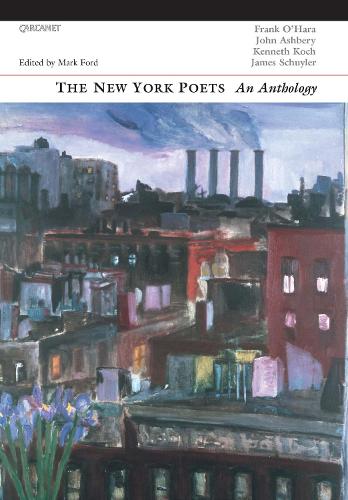
The New York Poets: an anthology
paperback
Published:
1 March, 2004

Popular Books by John Ashbery
View All Books by John Ashbery

Description
Mark Ford's anthology is an essential introduction to four poets whose work has influenced poetry around the world. It includes detailed background information and a substantial bibliography.
More Details
| Type | Book |
|---|---|
| ISBN13 | 9781857547344 |
| ISBN10 | 1857547349 |
| Number Of Pages | 224 |
| Item Weight | 1000 g |
| Product Dimensions | 154 x 220 x 19 mm |
| Publisher / Reseller | Carcanet Press Ltd |
| Format | paperback |
Media Reviews
The London Review of Books:
Ashbery, Koch, O'Hara and Schuyler: a quartet of sublime jokers who imagined a city into existence. Deceptively simple surfaces overlay an intellectual and emotional exuberance of staggering daring.
English poetry was languishing in the Fifties.The Movement poets, united by nothing more bracing than "a negative determination to avoid bad principles", seemed beset by a genteel sobriety.Their verse, in the words of Al Alvarez, was "academic, administrative ... polite, knowledgeable, efficient, polished and, in its own way, even intelligent." But it was hardly likely to inspire a new generation, or to open poetry up to insight and experience and innovation.Modernist experiment had lost its impetus.It was slowing to a sludgy stop.
But across the Atlantic, creativity was on a roll.The New York art scene, a unique foment of ideas and people, was flourishing.This was the era of Abstract Expressionism, of Jackson Pollock, of Willem de Kooning, of iconoclasm and conflict and wild improvisation.Visual art was about action and energy.It broke with convention.And the whole of culture - including poetry - was swept up by its tide.
"New York poets, except I suppose the colour blind, are affected most by the floods of paint in whose crashing surf we all scramble," wrote James Schuyler in 1959.He was one of a group of four - the others being John Ashbery, Frank O'Hara and Kenneth Koch - all of whom were, in one way or another, directly involved with the visual arts, working as critics or curators or collaborating with painters.
These four poets were not actually a group in that they never set their aims in any definitive way.How could they have?They were resolutely unacademic, unprogrammatic, unprescriptive.But were certainly stimulated by each other. "We envied each other, we emulated each other, we were almost entirely dependant on each other for support," Koch later recalled.Like the Abstract Expressionists who inspired them, they shared a common stance, though not a common style.
Now, for the first time, Carcanet gathers their work into an anthology: The New York Poets, edited by mark Ford.If the English reader wants to find out what happened to Modernism, to discover what become of the innovations of Pound or Eliot or, perhaps even more directly, where the expansiveness of Auden went, he need only flick through a few pages of this volume.They crossed the Atlantic.
... these poets belong together.Their works echo each other: they have attitude.They evoke a fresh way of thinking, a new freedom from rules as they embrace all the energy, the distraction of their era."You can't plan on the heart" writes O'Hara, "but the better part of it, my poetry, is open."
The New York poets create on a vast empty canvas.They let the forces of poetry buffet them about.This anthology can serve only as an introduction.Just a fraction from the 500 odd poems from the collected edition of O'Hara's work can be reproduced, for example.But with a few omissions (where is Ashbery's benchmark poem 'The Tennis Court Oath'?) the editor has sought to represent them in all their diversity and daring.
The reader feels the electricity that fizzles through their lines, frazzling academic conventions, exploding grammatical rules, spitting the bright sparks that smouldered and ignited a new postmodern mindset.
Gareth Twose, Poetry Nottingham, Issue 58: Winter 2004
What is different and innovative about the new Carcanet anthology, The New York Poets, is it allows the reader to see how the quartet of Frank O'Hara, John Ashbery, Kenneth Koch and James Schuyler functioned, creatively, (and albeit briefly) as a group, a collective entity. As the sharp and informed introduction by Mark Ford makes clear, all four were friends, collaborated on writing projects and acted as each other's best critics. The poetry both celebrated their friendship and was the creative engine room that drove it...
The other innovative thing about the anthology is the clear links it makes between the poets and the arts scene in New York, a scene whose luminaries included abstract expressionists like Pollock, Rothko and De Kooning. As the introduction by Mark Ford makes clear, all four poets either had professional connnections with the art world, or collaborated artistically with painters.
The anthology locates the writers within a very particular social and cultural context, something which is very helpful for first-time readers. It contains a really good bibliography of further primary and secondary material relating to the writers, so you know exactly where to go if you want to read more. But, most importantly, this anthology, perhaps for the first time, allows the reader to see the creative inter-relationships between these four writers, and for that reason alone I would strongly recommend it.
The London Review of Books:
Ashbery, Koch, O'Hara and Schuyler: a quartet of sublime jokers who imagined a city into existence. Deceptively simple surfaces overlay an intellectual and emotional exuberance of staggering daring.
The London Review of Books:
Ashbery, Koch, O'Hara and Schuyler: a quartet of sublime jokers who imagined a city into existence. Deceptively simple surfaces overlay an intellectual and emotional exuberance of staggering daring.
The London Review of Books:
Ashbery, Koch, O'Hara and Schuyler: a quartet of sublime jokers who imagined a city into existence. Deceptively simple surfaces overlay an intellectual and emotional exuberance of staggering daring.
GoodReads Reviews
Author's Bio
John Ashbery was born in Rochester, New York, in 1927. His books of poetry include Breezeway; Quick Question; Planisphere; Notes from the Air: Selected Later Poems, which was awarded the 2008 International Griffin Poetry Prize; A Worldly Country; Where Shall I Wander; and Self-Portrait in a Convex Mirror, which received the Pulitzer Prize for Poetry, the National Book Critics Circle Award, and the National Book Award. The winner of many prizes and awards both nationally and internationally, in 2011 he received the Medal for Distinguished Contribution to American Letters from the National Book Foundation, and in 2012 he received a National Humanities Medal, presented by President Obama at the White House. He lived in New York until his death, aged ninety, in 2017. Kenneth Koch is grouped with John Ashbery, Frank O'Hara and James Schuyler, a grouping which tends to underplay the real differences between each poet's projects; their collaborations were inventive because of their differences, not their similarities, and what marks all four is the ability to work at tangents without ever quite abandoning the circumference. Koch started writing when he was five, under the influence of Shelley, whom he outgrew in his teens, taking doses of Byron and eventually of Eliot. As a soldier in the Philippines, he kept himself sane by playing in language, making lines to make life's unbearables absurd. He studied at Harvard with Delmore Schwartz, and Ashbery and O'Hara were classmates. His prose memoirs, plays and poems have an abundance and a formal variety unparalleled in American writing. His Selected Poems and One Train are published in the United Kingdom by Carcanet. Frank O’Hara was born in Baltimore, Maryland, in 1926, and grew up in Grafton, Massachusetts. He served in the US navy (1944-46) in the South Pacific, and attended the universities of Harvard and Michigan. In 1951 O’Hara settled in Manhattan, and soon became a central figure in a number of the city’s artistic circles. For most of the fifteen years that he lived in New York he worked at the Museum of Modern Art, graduating from the front desk to become Associate Curator. He was a passionate advocate of Abstract Expressionist painters such as Willem de Kooning, Jackson Pollock, and Franz Kline. O’Hara wrote an enormous quantity of poetry, little of which was published during his lifetime, but which was much admired by friends such as John Ashbery, Kenneth Koch, V.R. 'Bunny' Lang, James Schuyler, Fairfield Porter and Larry Rivers. He died on 25 July 1966, from injuries sustained in a beach-buggy accident on Fire Island. He is buried at Green River Cemetery, East Hampton, Long Island. His Collected Poems (edited by Donald Allen) was published in 1971, and won the National Book Award for Poetry. James Schuyler was born in Chicago on 9 November 1923. He attended Bethany College of West Virginia from 1941 to 1943. In the late 40s he moved to New York City where he worked for NBC and befriended W. H. Auden. He later moved to Italy, where he lived in Auden's rented apartment and worked as his secretary. He attended the University of Florence between 1947 and 1948. He returned to the United States afterwards, and settled in New York City, where he lived with John Ashbery and Frank O'Hara. On 12 April 1991, he died following a stroke. Mark Ford was born in 1962. His publications include two collections of poetry, Landlocked (Chatto & Windus 1991, 1998) and Soft Sift (Faber & Faber 2001, Harcourt Brace 2003); a critical biography of the French poet, playwright and novelist Raymond Roussel (Raymond Roussel and the Republic of Dreams, Faber & Faber, 2000, Cornell University Press, 2001), a collection of essays, A Driftwood Altar (Waywiser Press, 2005), a 20,000-word interview with John Ashbery (Between the Lines, 2003), and, for Carcanet, The New York Poets, an anthology of poems by Frank O'Hara, John Ashbery, Kenneth Koch and James Schuyler (2003), The New York Poets II: An Anthology (2006) and 'Why I am not a painter' and other poems, a selection of the poetry of Frank O'Hara (2003). Mark Ford is a regular contributor to the New York Review of Books and the London Review of Books. He teaches in the English department at University College, London.