Controlling Chaos :Suppression, Synchronization and Chaotification - Communications and Control Engineering
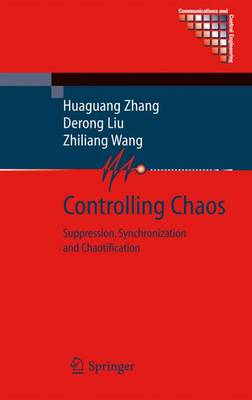
Controlling Chaos :Suppression, Synchronization and Chaotification - Communications and Control Engineering
hardback
Published:
27 July, 2009

Popular Books by Huaguang Zhang
View All Books by Huaguang Zhang

Description
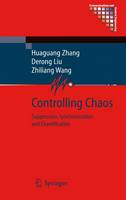
Controlling Chaos achieves three goals: the suppression, synchronisation and generation of chaos, each of which is the focus of a separate part of the book. The text deals with the well-known Lorenz, Rössler and Hénon attractors and the Chua circuit and with less celebrated novel systems. Modelling of chaos is accomplished using difference equations and ordinary and time-delayed differential equations. The methods directed at controlling chaos benefit from the influence of advanced nonlinear control theory: inverse optimal control is used for stabilization; exact linearization for synchronization; and impulsive control for chaotification. Notably, a fusion of chaos and fuzzy systems theories is employed. Time-delayed systems are also studied. The results presented are general for a broad class of chaotic systems.
This monograph is self-contained with introductory material providing a review of the history of chaos control and the necessary mathematical preliminaries for working with dynamical systems.
More Details
| Type | Book |
|---|---|
| ISBN13 | 9781848825222 |
| ISBN10 | 1848825226 |
| Number Of Pages | 344 |
| Item Weight | 1000 g |
| Publisher / Reseller | Springer London Ltd |
| Format | hardback |
| Edition | 2009 ed. |
Media Reviews
From the reviews:
“In this book the authors present state-of-the-art techniques for active control and synchronization of chaotic systems. … the book is written in a clear and concise fashion and each chapter contains a list of up-to-date references. … The book should be valuable to graduate students and faculty in engineering, or to applied mathematicians and physicists interested in the field of nonlinear dynamics and control theory. … It is recommended for individuals as well as libraries.” (Subhash C. Sinha, International Journal of Acoustics and Vibration, Vol. 16 (1), 2011)