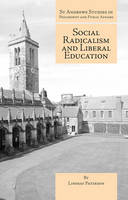
Social Radicalism and Liberal Education - St Andrews Studies in Philosophy and Public Affairs
Social Radicalism and Liberal Education - St Andrews Studies in Philosophy and Public Affairs
paperback
Published:
15 August, 2015

Popular Books by Lindsay Paterson
View All Books by Lindsay Paterson
Description
Liberal education used to command wide political support. Radicals disagreed with conservatives on whether the best culture could be appreciated by everyone, and they disagreed, too, on whether the barriers to understanding it were mainly social and economic, but there was no dispute that any worthwhile education ought to hand on the best that has been thought and said. That consensus has vanished since the 1960s. The book examines why social radicals supported liberal education, why they have moved away from it, and what the implications are for the future of an intellectually stimulating and culturally literate education.
More Details
| Type | Book |
|---|---|
| ISBN13 | 9781845407520 |
| ISBN10 | 1845407520 |
| Number Of Pages | 310 |
| Item Weight | 400 g |
| Product Dimensions | 135 x 210 x 17 mm |
| Publisher / Reseller | Imprint Academic |
| Format | paperback |
Media Reviews
"This book is about aspirations, in particular the left wing attitude to liberal education for the working classes in Britain." -- Euan Marley OP * New Blackfriars *
"A cursory glance at trends in contemporary education and the philosophy of education would probably leave the observer with the impression that the progressive view is one that favours childcentredness and a relativistic multi-culturalism, while at the same time undermining the authority of the teacher and the value of a curriculum based on high cultural values. In Social Radicalism and Liberal Education... Lindsay Paterson shows emphatically that this was not always the case." -- Booknotes * Philosophy *
"This fascinating and forensic analysis shows how the British liberal-Left gave up on aspirations for working class access to liberal, universal notions of knowledge as a means of emancipation. In Paterson's sobering testament to the pressing need for historical memory, advocates of 'progressive' or 'radical' education came to replace class history with case history, and to present individual self-hood in the name of class-consciousness and cultural recognition in the name of social justice. The book illuminates all too well that, outside a dwindling social elite, education at all levels now offers an increasingly instrumental vocational curriculum that eulogises 'skills' in employability, learning to learn and personal development." -- Sheffield University
"Lindsay Paterson has produced a fascinating work that traces the social radicalism present in liberal education from the mid-19th Century to the present drawing on a wealth of innovative research. This book deepens our understanding of liberal education and it clarifies the contemporary importance of these ideas for public policy." -- Durham University
"An ideal of liberal education is one of the most valuable legacies of western culture. This work explores the unfortunate demise of this ideal among its most ardent twentieth century former supporters on the political left. However, Professor Paterson's eloquent defence of liberal education in this ground-breaking work is perhaps all the more timely given the wider assaults to which this ideal - and the respect for the wisdom of the past that it embodies - has been prone from a variety of contemporary cultural and political directions." -- Birmingham University