Massacre at the Champ de Mars :Popular Dissent and Political Culture in the French Revolution - Royal Historical Society Studies in History New Series
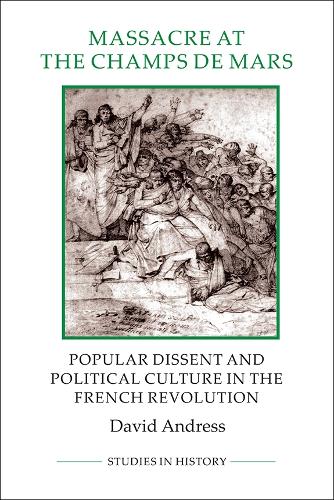
Massacre at the Champ de Mars :Popular Dissent and Political Culture in the French Revolution - Royal Historical Society Studies in History New Series
paperback
Published:
18 July, 2013
paperback
Published:
18 July, 2013

Standard worldwide delivery by
Fri, July 31 - Wed, August 5
Order within
0
Popular Books by David Andress
View All Books by David Andress



Description
The massacre exposed the widely differing ways in which post-Revolutionary Parisians construed the word "patriotism", and why the great Revolutionary goal of political unanimity was so elusive. On 17 July 1791 the revolutionary National Guard of Paris opened fire on a crowd of protesters: citizens believing themselves patriots trying to save France from the reinstatement of a traitor king. To the National Guard and theirpolitical superiors the protesters were the dregs of the people, brigands paid by counter-revolutionary aristocrats. Politicians and journalists declared the National Guard the patriots, and their action a heroic defence of the fledgling Constitution. Under the Jacobin Republic of 1793, however, this "massacre" was regarded as a high crime, a moment of truth in which a corrupt elite exposed its treasonable designs. This detailed study of the events of July 1791 and their antecedents seeks to understand how Parisians of different classes understood "patriotism", and how it was that their different answers drove them to confront each other on the Champ de Mars. David Andress is Professor of Modern History at the School of Social, Historical and Literary Studies, University of Portsmouth.
More Details
| Type | Book |
|---|---|
| ISBN13 | 9781843838425 |
| ISBN10 | 1843838427 |
| Number Of Pages | 256 |
| Item Weight | 388 g |
| Publisher / Reseller | Boydell & Brewer Ltd |
| Format | paperback |
See More +
Media Reviews
A creditable and serious job, which helps considerably our understanding of the relationship between the language of the street and popular revolutionary politics. * HISTORY *