Administrative Tribunals and Adjudication
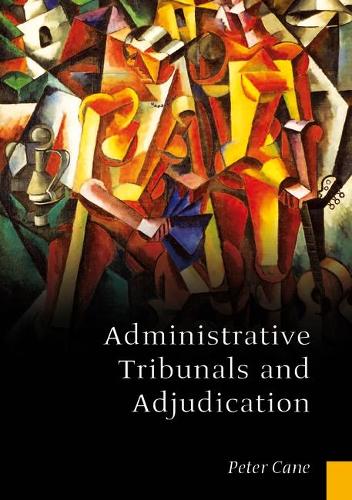
Administrative Tribunals and Adjudication
hardback
Published:
3 August, 2009

Popular Books by Professor Peter Cane
View All Books by Professor Peter Cane
Description
More Details
| Type | Book |
|---|---|
| ISBN13 | 9781841130095 |
| ISBN10 | 1841130095 |
| Number Of Pages | 312 |
| Item Weight | 650 g |
| Product Dimensions | 156 x 234 x 24 mm |
| Publisher / Reseller | Bloomsbury Publishing PLC |
| Format | hardback |
Media Reviews
...the book provides a clear theoretical analysis of administrative tribunals in different jurisdictions. Lin Feng Asia Pacific Law Review Volume 19, No. 2 Professor Cane's excellent book helps to redress the lack of academic attention paid to administrative tribunals. This is an outstanding account of Australian tribunal adjudication and its place in the regime of administrative decision-making and law. The detailed and sophisticated use of comparative law analysis helps to understand the choices that have been taken in Australia, what some of the alternatives were (and are), and also the constraints that will continue to shape administrative adjudication. Edward Santow Public Law Review 2010 Issue 21 Cane presents a precise, richly detailed account of administrative organizations, grounded in an impressive survey of the administrative law literature and Cane's own observations ... Such a detailed account is valuable because, as Cane notes, there is not much literature outside of Australia about what administrative tribunals do Readers will come away impressed with the breadth of research that Cane has conducted on these tribunals and the care with which he details the differences among them. Robert J. Hume Law and Politics Book Review April 6, 2010 While tribunals and merits review of administrative decisions may often be discussed in academic and practitioner literature, they are rarely the subject of theoretical, comparative, and historical examination. Peter Cane takes up this challenge in this book. Although it has its origins in debates about Australian administrative law, Professor Cane's book has a far broader scope and will be on interest to administrative lawyers in each of the countries examined. It achieves an impressive combination of broad historical and comparative analysis and fine assessment of the details and complexities of merits review. It develops significant insights, such as the distinction between implementation and adjudication, which highlight the substantive characteristics of merit review. It should become a primary reference for scholars researching accountability institutions. Andrew Edgar Public Law July 2010 Administrative Tribunals and Adjudication is a work of considerable scholarship, which throws new light on an important set of institutions that have not hitherto received the attention they deserve. Michael Adler Journal of Law and Society Volume 37, Number 3, 2010 ...this book tackles an area of great contemporary interest in the UK and does so with vigour and ability. Tom Royston Web Journal of Current Legal Issues 2010 The book is clearly and elegantly structured into seven chapters each analysing a different aspect of tribunals. The strengths of this book are to be found principally in the subtle blend of different types of analysis - constitutional, historical and comparative - used to appreciate the role and significance of tribunals. Cane presents a very scholarly and well-informed synthesis of three dimensions of tribunals: their functions across four jurisdictions, their historical development, and their constitutional significance. This book is very much to be welcomed as an excellent addition to the literature. It provides a valuable and wide-ranging study of an important but long neglected set of institutions and it should encourage administrative law scholars to pay much more attention to the work of tribunals. Robert Thomas The Cambridge Law Journal Volume 70, Part 1
Author's Bio
Peter Cane is Distinguished Professor of Law at the Australian National University College of Law. His other publications include Administrative Law 4th edn (Oxford, OUP, 2004) and (with Leighton McDonald) Principles of Administrative Law: Legal Regulation of Government (Melbourne, OUP, 2008). He is a Corresponding Fellow of the British Academy and a Fellow of the Academy of Social Sciences in Australia.