Poor Economics :The Surprising Truth about Life on Less Than $1 a Day
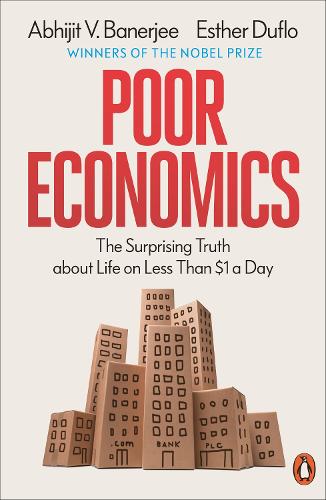
Poor Economics :The Surprising Truth about Life on Less Than $1 a Day
paperback
Published:
27 November, 2025

Popular Books by Abhijit V. Banerjee
View All Books by Abhijit V. Banerjee
Description
FULLY UPDATED EDITION WITH TWO NEW CHAPTERS
From the winners of the 2019 Nobel Prize in Economics
Why would a man in Morocco who doesn't have enough to eat buy a television?
Why do the poorest people in India spend 7 percent of their food budget on sugar?
Does having lots of children actually make you poorer?
This eye-opening book overturns the myths about what it is like to live on very little, revealing the unexpected decisions that millions of people make every day. Looking at some of the most paradoxical aspects of life below the poverty line - why the poor need to borrow in order to save, why incentives that seem effective to us may not be for them, and why, despite being more risk-taking than high financiers, they start businesses but rarely grow them - Banerjee and Duflo offer a new understanding of the surprising way the world really works.
Winner of the FT Goldman Sachs Business Book of the Year Award 2011
'Refreshingly original, wonderfully insightful . . . an entirely new perspective' Guardian
More Details
| Type | Book |
|---|---|
| ISBN13 | 9781837312405 |
| ISBN10 | 1837312400 |
| Number Of Pages | 400 |
| Item Weight | 296 g |
| Product Dimensions | 129 x 197 x 22 mm |
| Publisher / Reseller | Penguin Books Ltd |
| Format | paperback |
Media Reviews
To cut to the chase: this is the best book about the lives of the poor that I have read for a very, very long time * Economist *
A page-turner about the micro-economics of aid policy might not sound too probable, but that's what [Banerjee and Duflo] have written, and it is a truly remarkable book . . . unmistakably contemporary, written beautifully * Guardian *
It is the rich and humane portrayal of the lives of the very poor that most impresses. [The authors] show how those in poverty make sophisticated calculations in the grimmest of circumstances … Books such as these offer a better path forward * Financial Times *
Overturns many received ideas about what it's like to be poor -- Hari Kunzru * Observer *
A compelling and important read … an honest and readable account about the poor that stands a chance of actually yielding results * Forbes *
Marvellous, rewarding … the sheer detail and warm sympathy on display reflects a true appreciation of the challenges their subjects face * Wall Street Journal *
A remarkable work: incisive, scientific, compelling and very accessible, a must-read * Financial World *
Banerjee and Duflo assemble a fascinating assortment of interventions from across the globe in their book … It is engaging and informative * Business World (India) *
A marvellously insightful book by two outstanding researchers on the real nature of poverty -- Amartya Sen
It has been years since I read a book that taught me so much -- Steven D. Levitt
Author's Bio
Abhijit V. Banerjee (Author)
Abhijit Banerjee, winner of the 2019 Nobel Prize in Economics, is the Ford Foundation International Professor of Economics at the Massachusetts Institute of Technology, and a co-founder and co-director of the Abdul Latif Jameel Poverty Action Lab (J-PAL). In 2011, he was named one of Foreign Policy magazine’s top 100 global thinkers. Banerjee served on the U.N. Secretary-General’s High-level Panel of Eminent Persons on the Post-2015 Development Agenda.
Esther Duflo (Author)
Esther Duflo, winner of the 2019 Nobel Prize in Economics, is the Abdul Latif Jameel Professor of Poverty Alleviation and Development Economics in the Department of Economics at the Massachusetts Institute of Technology and a co-founder and co-director of the Abdul Latif Jameel Poverty Action Lab (J-PAL). Duflo is a member of the American Academy of Arts and Science, and has received numerous academic honors and prizes including the Princess of Asturias Award for Social Sciences (2015), the Infosys Prize (2014), the Dan David Prize (2013), a John Bates Clark Medal (2010), and a MacArthur “Genius Grant” Fellowship (2009).