The Archaeology of Tanamu 1 :A Pre-Lapita to Post-Lapita Site from Caution Bay, South Coast of Mainland Papua New Guinea - Caution Bay Studies in Archaeology
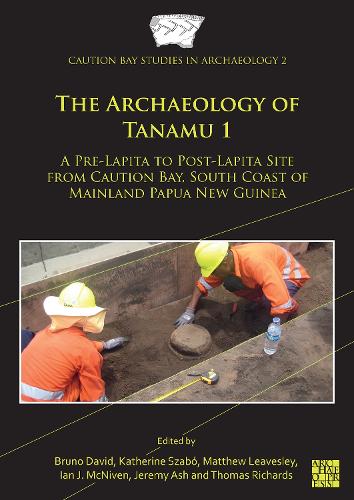
The Archaeology of Tanamu 1 :A Pre-Lapita to Post-Lapita Site from Caution Bay, South Coast of Mainland Papua New Guinea - Caution Bay Studies in Archaeology
paperback
Published:
31 May, 2022

Popular Books by Bruno David
View All Books by Bruno David
Description
Sites and layers interdigitate across the Caution Bay landscape to reveal a 5000-year story, each site contributing unique details of the grander narrative. Positioned near the coast on a sand ridge, Tanamu 1 contains three clear occupational layers: a pre-Lapita horizon (c. 4050–5000 cal BP), a Late Lapita horizon (c. 2750–2800 cal BP), and sparser later materials capped by a dense ethnohistoric layer deposited in the past 100–200 years. Fine-grained excavation methods, detailed specialist analyses and a robust chronostratigraphy allows for a full and transparent presentation of data to start laying the building blocks for the Caution Bay story.
More Details
| Type | Book |
|---|---|
| ISBN13 | 9781803270883 |
| ISBN10 | 1803270888 |
| Number Of Pages | 370 |
| Item Weight | 1310 g |
| Product Dimensions | 205 x 290 x 16 mm |
| Publisher / Reseller | Archaeopress |
| Format | paperback |
Author's Bio
Bruno David is Professor of Indigenous Archaeology at Monash University and is a Chief Investigator with the Australian Research Council Centre of Excellence for Australian Biodiversity and Heritage. He specialises in landscape archaeology, the archaeology of rock art, and the archaeology of Indigenous Australia and Papua New Guinea. His latest books are The Oxford Handbook of the Archaeology and Anthropology of Rock Art, and The Oxford Handbook of the Archaeology of Indigenous Australia and New Guinea (both co-edited with Ian J. McNiven). ;
Katherine Szabó studied archaeology in New Zealand and Australia and has held research fellowships and academic positions in Australia, the United States, Germany and the United Kingdom. She has pioneered research into the use of shell as a raw material for artefact production and has worked on archaeological material spanning Pleistocene to ethnohistorical collections from across the Asia-Pacific region. ;
Matthew Leavesley joined the University of Papua New Guinea as a lecturer in 2006. He has undertaken research in all four regions of Papua New Guinea and many different provinces. He is interested in both evolutionary and ethnographic approaches to archaeology. ;
Ian J. McNiven is Professor of Indigenous Archaeology at the Monash Indigenous Studies Centre, Monash University, Melbourne, and a Chief Investigator with the Australian Research Council Centre of Excellence for Australian Biodiversity and Heritage. He is an elected Fellow of the Society of Antiquaries London, the Royal Anthropological Institute, and the Australian Academy of the Humanities. ;
Jeremy Ash is an archaeologist at the Monash Indigenous Studies Centre at Monash University. His work focuses on the archaeology of the recent past, with particular interests in agency, archaeological and Indigenous storytelling, historicising ancestral landscapes and the archaeology of missions and frontiers. ;
Thomas Richards is Executive Director of the Heritage Conservation Branch in the Government of Saskatchewan, Canada and Adjunct Senior Research Fellow with the Monash Indigenous Studies Centre, Monash University, Australia. As a director of the Caution Bay Archaeology Project since 2009, Tom has been involved in researching Lapita settlements, as well as sites from earlier and later periods, from the south coast of Papua New Guinea.