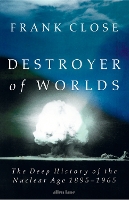
Destroyer of Worlds :The Deep History of the Nuclear Age: 1895-1965
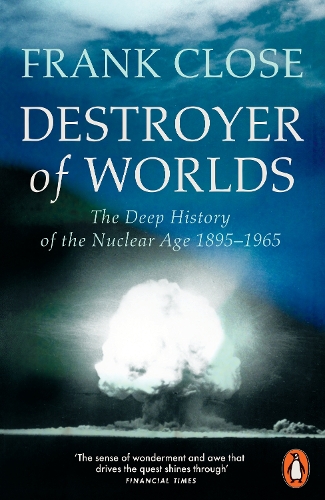
Destroyer of Worlds :The Deep History of the Nuclear Age: 1895-1965
paperback
Pre-Order Published On:
6 August, 2026

Popular Books by Frank Close
View All Books by Frank Close
Description
**A Guardian Best Science and Nature Book of 2025**
From the award-winning science writer, a new history of the development of nuclear power and the extraordinary minds behind it
Henry Becquerel’s accidental discovery, in Paris in 1896, of a faint smudge on a photographic plate sparked a chain of discoveries which would unleash the atomic age.
Destroyer of Worlds is the story of how pursuit of this hidden source of nuclear power, which began innocently and collaboratively, was overwhelmed by the politics of the 1930s, and following devastation of Hiroshima and Nagasaki opened the way to a still more terrible possibility: a thermonuclear bomb, the so-called “backyard weapon”, that could destroy all life on earth – from anywhere.
The story spans decades and continents, moving from Becquerel to Ernest Rutherford, the Cambridge-based, New Zealand scientist who first split the atom, expands to include Enrico Fermi in Rome, Otto Hahn and Lise Meitner in Berlin and the Joliot-Curies in Paris, leading to the appearance of Robert Oppenheimer before climaxing with increasingly horrifying developments in the USA and USSR. The roles of three remarkable women – Lise Meitner, Ida Noddack and Irene Curie – are re-evaluated, and there are new insights into the work of Ettore Majorana, Fermi’s mercurial but brilliant assistant, who mysteriously disappeared in 1938, possibly after foreseeing the explosive power of nuclear energy. Above all, this is a story of how knowledge is often advanced by personal convictions and relationships, an indeed by chance, in a remarkable way.
More Details
| Type | Book |
|---|---|
| ISBN13 | 9781802066029 |
| ISBN10 | 1802066020 |
| Number Of Pages | 336 |
| Item Weight | 278 g |
| Product Dimensions | 130 x 196 x 21 mm |
| Publisher / Reseller | Penguin Books Ltd |
| Format | paperback |
Media Reviews
Stirring ... Close's ensemble drama is a powerful corrective to the myth of the solitary genius. An eminent theoretical physicist, he walks us step-by-step through what he calls the 'Third Industrial Revolution', [shining] a light on the bustling cast of scientists whose 50-year pursuit of knowledge led ineluctably to the atomic bomb. The depth of Close's knowledge throws up surprises even if you know the territory ... he convenes these fascinating personalities deftly and has an abundant supply of thrills, tragedies and gratifying trivia * Spectator *
Close writes with elegance and lucidity about the resulting experiments and investigations [and] the breakthroughs that led to the atom bomb [so that] the sense of wonderment and awe that drives the quest shines through. Close also turns the spotlight on figures often forgotten, such as Ettore Majorana, a young Sicilian physicist, whom Fermi rated as a genius to rank alongside Newton and who did much to unravel the mysteries of atomic structure * Financial Times *
Close tells the remarkable story of the science behind the nuclear age, ,beginning with Henri Becquerel’s serendipitous discovery in 1896 of smudges on a photographic plate that had been placed in a drawer with phosphorescent crystals of uranium ... [he] brings the complex field of nuclear physics vividly alive, showing how the nuclear story is one of “incremental discoveries, like building a tower one layer at a time” -- P. D. Smith * Times Literary Supplement *
A magisterial account of an exciting—and often courageous—area of scientific endeavour * Prospect *
Author's Bio
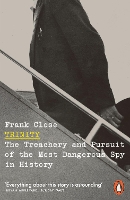
Frank Close is a Fellow of the Royal Society, Professor Emeritus of Theoretical Physics at Oxford University and Fellow Emeritus in Physics at Exeter College, Oxford. He is the author of The Infinity Puzzle: Quantum Field Theory and the Hunt for an Orderly Universe and most recently Trinity: The Treachery and Pursuit of the Most Dangerous Spy in History. He was formerly Head of the Theoretical Physics Division at the Rutherford Appleton Laboratory at Harwell and Head of Communications and Public Education at CERN. He was awarded the Kelvin Medal of the Institute of Physics for his 'outstanding contributions to the public understanding of physics' in 1996, and the Royal Society Michael Faraday Prize for communicating science in 2013.