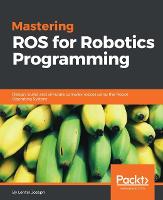
Mastering ROS for Robotics Programming :Best practices and troubleshooting solutions when working with ROS
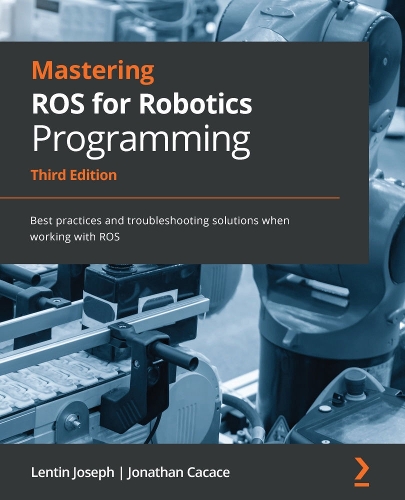
Mastering ROS for Robotics Programming

Mastering ROS for Robotics Programming :Best practices and troubleshooting solutions when working with ROS

paperback
Published: 28 October, 2021
Standard worldwide delivery by Fri, July 17 - Wed, July 22
Order within 0
Condition: NEW
$84.55
Price includes shipping
Available 20+ in stock
- +
FREE Returns within 30 days

Description

Develop, simulate, and deploy intelligent robotic systems using ROS with hands-on guidance for 3D modeling, hardware integration, and motion planning Key Features Implement complex simulations using Gazebo, Webots, and CoppeliaSim alongside MoveIt! for motion planning Integrate sensors, vision modules, and I/O boards for real-world robot control Bridge ROS with MATLAB, Simulink, and industrial robots for advanced deployments Book DescriptionThe Robot Operating System (ROS) is a software framework used for programming complex robots. ROS enables you to develop software for building complex robots without writing code from scratch, saving valuable development time. Mastering ROS for Robotics Programming provides complete coverage of the advanced concepts using easy-to-understand, practical examples and step-by-step explanations of essential concepts that you can apply to your ROS robotics projects. The book begins by helping you get to grips with the basic concepts necessary for programming robots with ROS. You'll then discover how to develop a robot simulation, as well as an actual robot, and understand how to apply high-level capabilities such as navigation and manipulation from scratch. As you advance, you'll learn how to create ROS controllers and plugins and explore ROS's industrial applications and how it interacts with aerial robots. Finally, you'll discover best practices and methods for working with ROS efficiently. By the end of this ROS book, you'll have learned how to create various applications in ROS and build your first ROS robot.What you will learn Create a robot model with a 7-DOF robotic arm and a differential wheeled mobile robot Work with Gazebo, CoppeliaSim, and Webots robotic simulators Implement autonomous navigation in differential drive robots using SLAM and AMCL packages Interact with and simulate aerial robots using ROS Explore ROS pluginlib, ROS nodelets, and Gazebo plugins Interface I/O boards such as Arduino, robot sensors, and high-end actuators Simulate and perform motion planning for an ABB robot and a universal arm using ROS-Industrial Work with the motion planning features of a 7-DOF arm using MoveIt Who this book is forThis book is ideal for robotics engineers, researchers, or software developers familiar with Linux and C++ who want to deepen their ROS expertise. It’s especially valuable for those building real-world robot applications using simulation tools, MoveIt!, and sensor integration. A working knowledge of basic ROS concepts is expected.
See more

More Details

Type Book
ISBN13 9781801071024
ISBN10 1801071020
Number Of Pages 594
Item Weight 1000 g
Publisher / Reseller Packt Publishing Limited
Format paperback
Edition 3rd Revised edition
See More +

Author's Bio

Lentin Joseph is the Co-Founder of RUNTIME Robotics. He brings over 14 years of experience in Robotics Software Development, specializing in ROS 1 and 2. He has authored and reviewed over 10 books on ROS, computer vision, and embedded systems. Lentin holds a master's in Robotics and Automation from Amrita University, Kerala, and a bachelor's degree in Electronics and Communication Engineering from FISAT Engineering College, Kerala. His passion for teaching Robotics and ROS has also led him to share his insights as a TEDx Speaker. Jonathan is an experienced and enthusiastic robotic software developer. He has over 10 years of experience in different robotic fields, from mobile robotics (aerial and ground) to industrial and advanced manipulation. His background is in computer science. After university studies, he got a PhD in robotics from the University of Naples Federico II, where he could participate in various research and industrial projects in different robotics fields. Currently, he is a researcher at Eurecat, the technology center of Catalonia.

Show more