Marxism and Phenomenology :The Dialectical Horizons of Critique - Continental Philosophy and the History of Thought
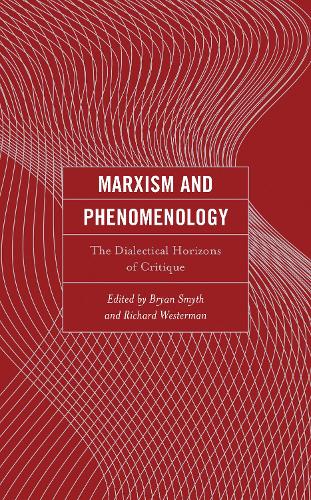
Marxism and Phenomenology :The Dialectical Horizons of Critique - Continental Philosophy and the History of Thought
hardback
Published:
25 October, 2021

Popular Books by Bryan Smyth
View All Books by Bryan Smyth
Description
More Details
| Type | Book |
|---|---|
| ISBN13 | 9781793622556 |
| ISBN10 | 1793622558 |
| Number Of Pages | 276 |
| Item Weight | 694 g |
| Product Dimensions | 161 x 227 x 26 mm |
| Publisher / Reseller | Bloomsbury Publishing Plc |
| Format | hardback |
Media Reviews
A pathbreaking critical volume that reconstructs the parallels and lines of convergence between Marxism and the phenomenological tradition. It gathers a compelling series of essays by leading scholars in the field to reveal the urgency of a phenomenological critique of capitalism for a critical theory of society, diving deeply into the pressing themes of ecology, ethics, reification, colonialism, and praxis. -- Anita Chari, University of Oregon
The intellectual landscape of 20th century Europe was shaped by two major trends, phenomenology and Marxism. While the Soviets rejected phenomenology, many of the most important European Marxists relied on phenomenology to explain the lived experience of class, labor, revolution, and anti-colonial struggle. Lukacs, Gramsci, Marcuse, Benjamin, Fanon, Kosik, Sartre and Merleau-Ponty proposed alternatives to the Soviet version of Marxism. Their work responded to the highest demands of philosophy in their time and ours. Today, these thinkers offer the best hope for a renewal of Marxist philosophy. Marxism and Phenomenology: The Dialectical Horizons of Critique reviews the work of many of these precursors and contributes exciting new perspectives. -- Andrew Feenberg, Simon Fraser University
This is an excellent collection of essays on phenomenology and Marxism. It gives a precise account of the history and typology of phenomenological Marxism, represented by Husserlian, Heideggerian, and Existential Marxism. However, its main focus is not merely historical but rather systematic. Indeed, by employing concepts and methodologies stemming from both currents of thought, the contributors set themselves the task to renew an interrupted dialogue within new intellectual, political, and social contexts. I dare say that they have succeeded in their efforts.
They demonstrate that Marxism is not only about objective laws of history or economic structure, but also covers human subjectivity, spontaneity, lived experience, and self-understanding. Correspondingly, phenomenology is not thematically limited to the issues of consciousness, intentionality, or Ego, as it has rich conceptual recourses to theorize embodiment, human needs, labour, alienation and reification, and even emancipation.
This is essential reading for those seriously interested in recent debates in political and social philosophy, as well as in new trends in phenomenology and Marxism.
The dialogue goes on.
“While phenomenology and Marxism for the most part occupy different theoretical and practical spaces, there are also points of intersection and complementarity—at times productive, at times fraught with difficulties—between these traditions. This volume establishes a few indispensable waypoints that will help the reader to traverse this rich and complex terrain.” -- Iain Macdonald, Université de Montréal
Author's Bio
Bryan Smyth is visiting assistant professor of philosophy at the University of Mississippi.
Richard Westerman is associate professor of sociology at the University of Alberta.