Culturally Responsive Strategies for Reforming STEM Higher Education :Turning the TIDES on Inequity
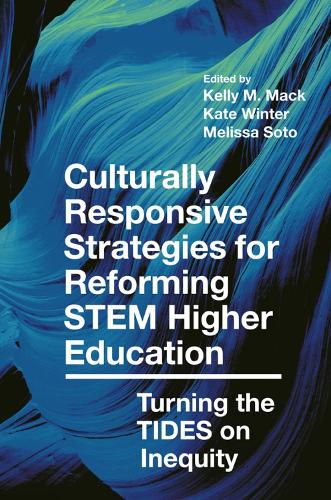
Culturally Responsive Strategies for Reforming STEM Higher Education :Turning the TIDES on Inequity
hardback
Published:
14 January, 2019

Popular Books by Kate Winter
View All Books by Kate Winter


Description
More Details
| Type | Book |
|---|---|
| ISBN13 | 9781787434066 |
| ISBN10 | 1787434060 |
| Number Of Pages | 304 |
| Item Weight | 538 g |
| Product Dimensions | 152 x 229 x 20 mm |
| Publisher / Reseller | Emerald Publishing Limited |
| Format | hardback |
Media Reviews
Educators describe their experiences with the TIDES movement--Teaching to Increase Diversity and Equity in STEM--as a way of dealing the US back into the world competition in science, technology, engineering, and mathematics. Among the topics are cybernetic girls can be pinky: strategies to recruit and retain Latinas into STEM in the context of faculty-to-student empowerment, fostering an environment for all students to succeed in computer science: integrating culturally responsive pedagogies with curricula redesign, culturally responsive strategies for addressing recruitment and retention of women in STEM: online modules for building STEM majors' computational skills, equity through access to computer science learning at a small liberal art college, and interventions addressing recruitment and retention of under-represented minority groups in undergraduate STEM disciplines. -- Annotation ©2019 * (protoview.com) *
Author's Bio
Kelly Mack, PhD, is the Vice President for Undergraduate STEM Education and Executive Director of Project Kaleidoscope at the Association of American Colleges and Universities, USA. She currently serves as Principal Investigator of the TIDES Project. Kate Winter, PhD, leads the team at Kate Winter Evaluation, LLC (KWE). KWE's areas of evaluation expertise include broadening participation in STEM, college student access and retention, professional development for faculty, and institutional change. Melissa Soto, PhD, is Deputy Director of the Biology Scholars Program at the University of California, Berkeley, USA. Her previous work includes efforts at the National Science Foundation, the University of California, and the Association of American Colleges and Universities where she facilitated TIDES Project activities.