After Heidegger? - New Heidegger Research

After Heidegger? - New Heidegger Research
hardback
Published:
15 November, 2017

Popular Books by Gregory Fried
View All Books by Gregory Fried



Description
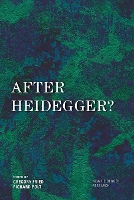
This unique volume collects more than 30 new essays by prominent scholars on what remains philosophically provocative in Heidegger’s thought. His writings continue to invite analysis and application — ut, particularly in the light of his political affiliations, they must also be critiqued. Philosophy today takes place after Heidegger in that his views should not be accepted naively, and there are new issues that he did not address — but also in that we continue to think in the wake of important questions that he raised.
The contributors to this volume ask questions such as:
- What does it mean to think “after” Heidegger?
- What is valuable in his early work on finite existence, and in his early and late phenomenology?
- What is the root of his political errors? Are there still elements in his thought that can yield helpful political insights?
- Should we emulate his turn toward “releasement”?
- Can he help us understand the postmodern condition?
Readers will find thought-provoking echoes and points of contention among these engaging and lively essays.
More Details
| Type | Book |
|---|---|
| ISBN13 | 9781786604859 |
| ISBN10 | 178660485X |
| Number Of Pages | 392 |
| Item Weight | 685 g |
| Product Dimensions | 159 x 237 x 30 mm |
| Publisher / Reseller | Bloomsbury Publishing PLC |
| Format | hardback |
Media Reviews
This extremely rich volume gathers more than thirty brand-new essays by leading scholars to explore the many meanings of “After Heidegger.” Is his philosophy a thing of the past? Is our way of thinking influenced by Heidegger like Francis Bacon’s “Study after Velázquez” is indebted to the Spanish painter? Do we go 'after' Heidegger like spurned lovers or dogged investigators? -- Dieter Thomä, Professor of Philosophy at the University of St Gallen, and editor of the Heidegger Handbuch
After a careful reading, the most striking traits of this volume are the diversity and the originality of the ways of thinking opened by dealing with Heidegger’s legacy […]. The substantial mix of the topics, which range from Heidegger’s fundamental questions […], concepts and ideas […], critiques […], his accounts on life, phenomenology, hermeneutics, ontology, art, poetry, history, to matters concerning his historical situation […], makes this volume relevant for a wide range of researchers. […] Overall, with its rich and original content, renowned international authors and thematic diversity, “After Heidegger?” has all the ingredients to be a sought-after milestone when one genuinely embarks on the adventure of thinking after Heidegger. * Meta: Research in Hermeneutics, Phenomenology, and Practical Philosophy *
After Heidegger? has the larger scope, in that it attempts to engage with pretty much every major phase and dimension of Heidegger's
intellectual career from his earliest teaching on life and existence to his late thoughts on East–West dialogue, with
a view to distinguishing what remains fruitful from what should be discarded.
Author's Bio
Gregory Fried is Professor of Philosophy at Suffolk University. With Richard Polt he has translated Heidegger’s Introduction to Metaphysics and Being and Truth, and edited A Companion to Heidegger’s “Introduction to Metaphysics” and Nature, History, State: 1933-1934.
Richard Polt is Professor of Philosophy at Xavier University. With Gregory Fried he has translated Heidegger’s Introduction to Metaphysics and Being and Truth, and edited A Companion to Heidegger’s “Introduction to Metaphysics” and Nature, History, State: 1933-1934.